Last updated: August 2026
Topic clusters SEO with AI works best when structure comes before scale. In 2026, the biggest gains often come from building clusters that feed both classic rankings and AI-generated answers. That means clearer intent splits, stronger internal links, and pages with enough substance to stand alone. If your current model is one pillar plus filler posts, it is time to rebuild the system around evidence, relationships, and measurable search demand.
TL;DR
- Topic clusters organize content around one core search intent.
- AI speeds research, clustering, and content gap discovery.
- Strong internal linking helps build topical authority.
- Pillar pages answer the broad question; cluster pages go deeper.
- Use a simple workflow to avoid cannibalization and scale smarter.
What topic clusters SEO means in practice
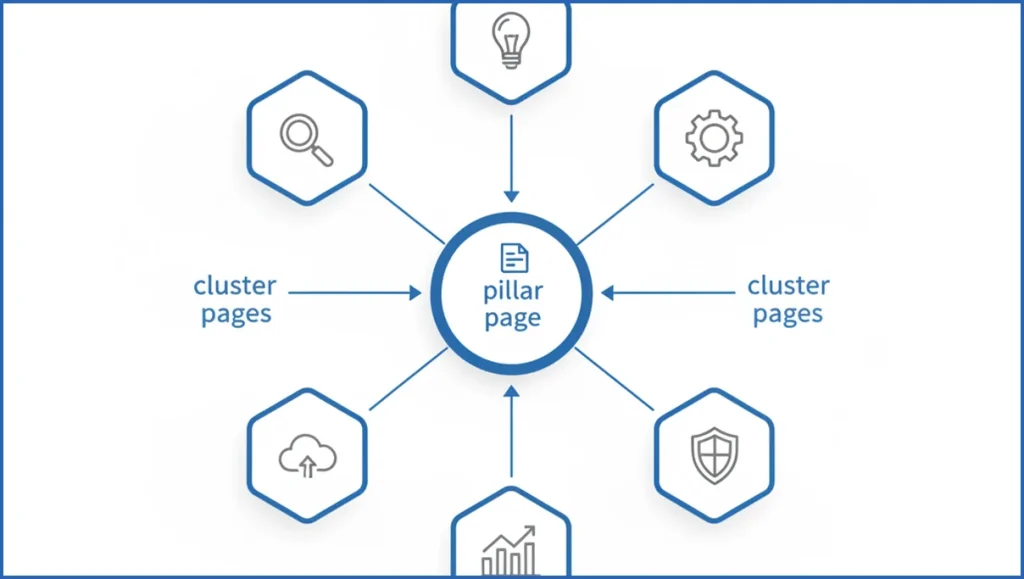
Topic clusters SEO means you build one central page for a broad intent, then support it with narrower pages that answer adjacent questions. The pillar page covers the landscape. Cluster pages handle specifics, such as tools, steps, costs, templates, or comparisons. That structure helps users move from overview to detail without friction.
A pillar page is not just a long article. It acts as the hub for a topic. If your pillar is “topic clusters SEO,” subpages might target “topic cluster examples,” “pillar page template,” and “keyword cannibalization in clusters.” This is close to how strong editorial sites plan authority, and it aligns well with a modern content planning model.
The payoff is clearer relevance. Google can see the relationship between pages when the links, headings, and intents line up. Users also send better signals when they find the next answer quickly. If you want visibility in AI-shaped search experiences, cluster depth matters even more, as covered in answer engine optimization.
Why AI changes how teams build topic clusters
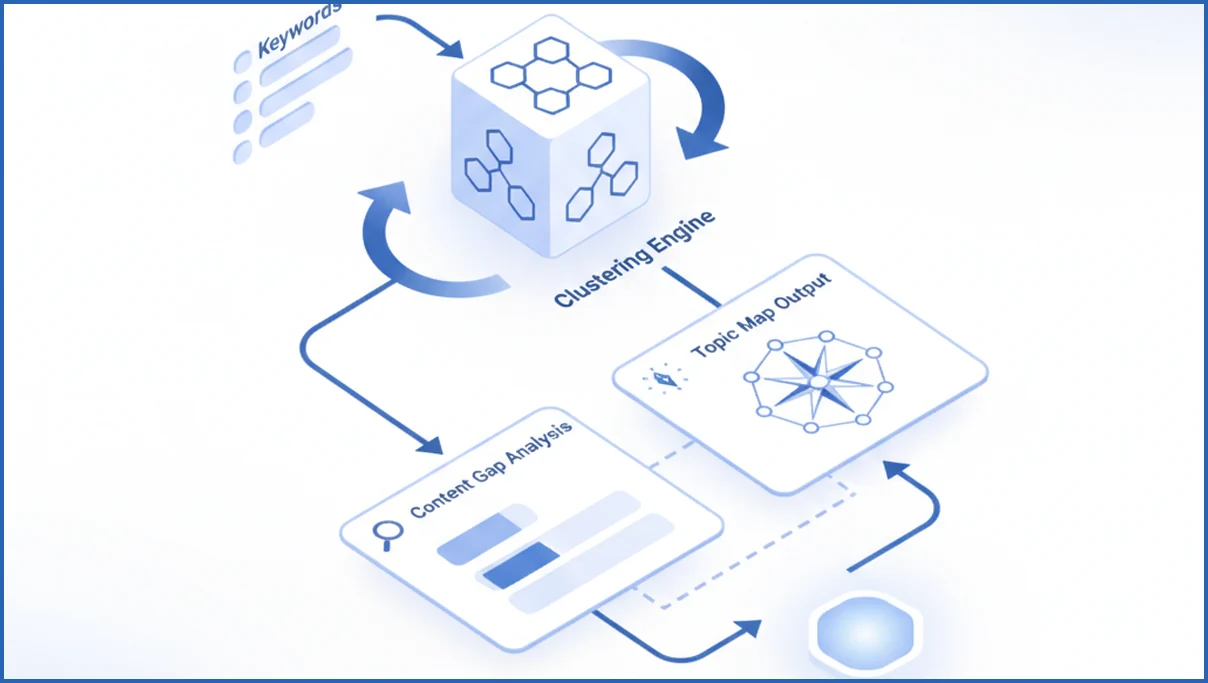
AI cuts hours from cluster building because it can group messy keyword exports, summarize SERPs, and suggest missing subtopics. What it should not do is pick the strategy alone. Teams still need to decide which intent deserves a pillar, which pages should merge, and where business value sits.
A useful pattern is: export Search Console queries, cluster by semantic similarity, then review intent manually. With the Google Search Console MCP, a team can pull query sets, inspect position 8-15 terms, and identify pages that deserve support. For larger editorial ops, AI-assisted keyword clustering is often the fastest way to turn raw queries into a map.
Example: a SaaS site sees 47 queries around “content brief template,” “SEO brief example,” and “AI content brief.” AI groups them together. The strategist then splits them into one pillar plus two subpages because the SERP intent differs. Speed comes from sorting. Accuracy comes from review.
Choose a core topic and map search intent
Start with a topic that is broad enough for a pillar, but narrow enough to own. “SEO” is too wide. “Topic clusters SEO” is viable because it has a clear problem, multiple sub-questions, and direct business relevance. Check whether the SERP shows guides, examples, tools, or service pages. That mix tells you the dominant intent.
Next, separate supporting questions by job to be done. Some users want definitions. Others want templates, workflows, or audits. If two keywords produce clearly different results, they likely need separate pages. This is where AI-shaped search behavior matters, because Google now surfaces more synthesized answers for broad informational terms.
- Pick one core phrase with commercial or strategic value.
- Review the top 10 results and note recurring page types.
- Group related queries by intent, not just by shared words.
- List 5-12 supporting pages before writing the pillar.
Build the cluster structure: pillar page, subpages, links
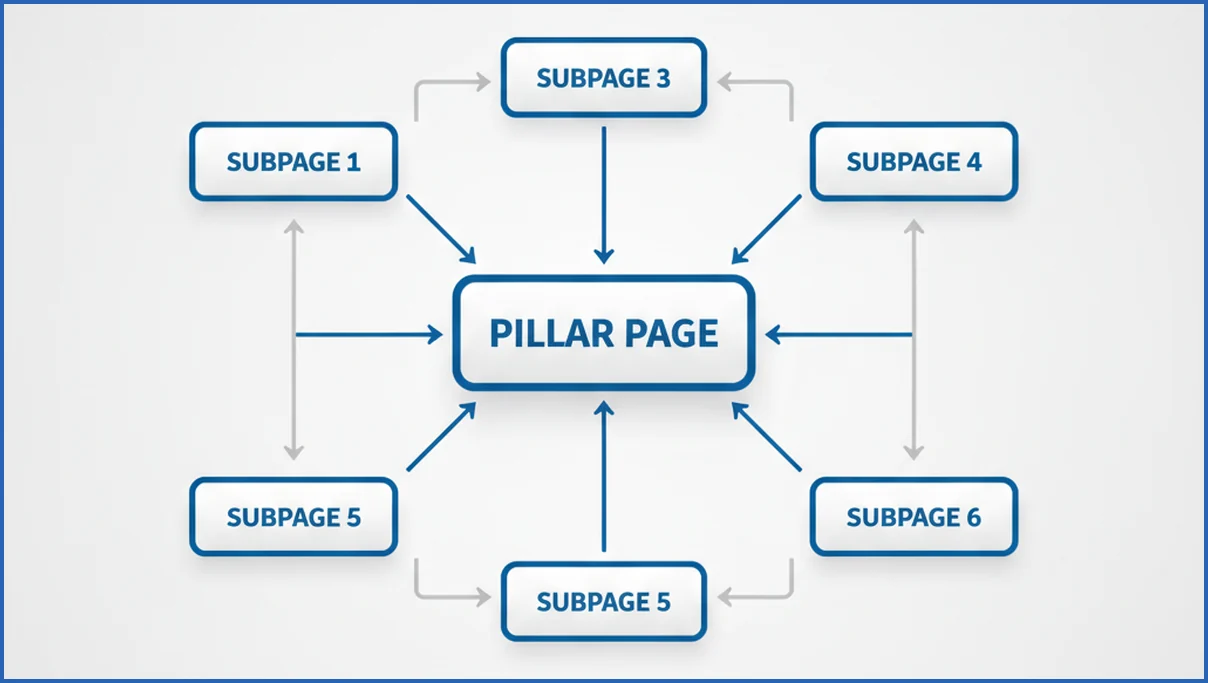
The structure should be boring and clear. One pillar page targets the broad topic. Each subpage targets one distinct intent and links back to the pillar with descriptive anchor text. Related subpages should also cross-link where that helps the reader finish a task.
A simple structure for this topic could look like this:
/topic-clusters-seo/
/topic-cluster-examples/
/pillar-page-template/
/keyword-cannibalization-in-clusters/
/internal-linking-for-topic-clusters/
/ai-topic-cluster-workflow/
Use links with purpose, not volume. If every article links to every other article, the cluster becomes noise. A cleaner rule is hub-to-spoke, spoke-to-hub, then spoke-to-spoke only when the next page solves the next question. Many teams formalize this in their on-page SEO workflow before content goes live.
Create content faster without losing quality
AI helps most at the brief stage. Give it the target query, SERP patterns, related questions, internal link targets, and product context. Then ask for an outline, missing angles, and objections to cover. That removes blank-page time without handing over editorial judgment.
One practical workflow is: AI draft brief, writer draft, expert review, editor pass, then final optimization. For example, a B2B team can use Claude to turn top-ranking headings into a draft brief, then layer in customer evidence and screenshots. Automating content briefs saves time, but subject matter review is what keeps the page useful.
Do not publish first drafts untouched. AI tends to flatten opinions, reuse generic examples, and miss product-specific nuance. Clusters win when each page feels like it belongs to the same site, but still adds something distinct.
Measure results and avoid common cluster mistakes
Track performance at the cluster level, not just page by page. Look at impressions, clicks, average position, assisted conversions, and internal link coverage. A cluster is working when the pillar and subpages rise together, and when supporting pages start ranking for long-tail variants the pillar cannot hold alone.
Common mistakes are easy to spot. Two pages target the same SERP. The pillar gets too detailed and steals the subpage’s job. Or new posts ship without links back to the hub. Using GA4 MCP data alongside Search Console helps you see whether rankings improve but engagement drops, which often signals intent mismatch.
Example: if two pages both rank positions 9 and 11 for “pillar page template,” merge them or retarget one. If a subpage earns impressions but no clicks, rewrite the title and sharpen the promise.
How to optimize clusters for AI Overviews and answer engines
Start by treating each cluster page as a possible citation source. AI Overviews often surface compact explanations, step lists, definitions, comparisons, and practical examples. Your pillar page should frame the topic and link to deeper pages. Supporting pages should answer one clear subtopic better than a generic blog post. That structure improves retrieval for both Google and other answer engines in many cases.
Write for extractability. Put the direct answer near the top, then expand with context, examples, and limitations. Use descriptive H2s, short paragraphs, numbered steps, and comparison tables where useful. If a page explains Shopify collection filters, GA4 event setup, or Ahrefs keyword grouping, name the product directly. Specificity gives AI systems cleaner passages to summarize. This aligns with the practical guidance in answer engine optimization.
Strengthen entity coverage across the cluster. If your pillar targets topic clusters SEO with AI, supporting pages can cover semantic grouping, intent classification, internal link design, schema, and measurement. Avoid near-duplicate intros across those pages. Instead, give each one a unique job and unique evidence. Original screenshots, first-party data, and expert commentary remain useful trust signals in many cases.
Finally, measure at page and cluster level. Watch impressions, clicks, assisted conversions, and query spread in Search Console. Look for pages gaining impressions from longer, question-based searches. That pattern often shows your cluster is becoming a better source for synthesized results. If you want tighter reporting, Google Search Console MCP tools can help speed recurring analysis and content refresh decisions.
How AI Mode changes topic cluster SEO in 2026
AI Mode rewards clusters that answer a topic from several angles, not pages that repeat one keyword. Google has shown a stronger shift toward synthesized responses and follow-up exploration in AI experiences, including AI Overviews and AI Mode features. That means your pillar page is now a routing asset, while supporting pages supply precise evidence, examples, comparisons, and definitions. For a broader breakdown, see Google AI Mode explained.
In practice, clusters need tighter intent mapping. One page should target the broad task, such as building a topic cluster strategy. Other pages should cover sub-questions like internal linking, entity coverage, content briefs, measurement, and common mistakes. AI systems can pull from any useful page in the cluster, so each URL needs standalone clarity. Strong headings, concise summaries, and original examples help machines extract trustworthy passages.
- Build pages around distinct tasks and questions, not close keyword variants.
- Add evidence blocks, examples, and definitions that AI systems can quote cleanly.
- Use internal links to show topical relationships and progression across the cluster.
Frequently Asked Questions
Is SEO dead or evolving in 2026?
SEO is evolving, not disappearing. Search now includes AI Overviews, richer SERP features, and more zero-click behavior, but people still need trustworthy sources. The practical shift is this: pages must answer broader questions, show real expertise, and connect related content well. Topic clusters fit that shift because they build depth instead of chasing isolated keywords.
What is the difference between a pillar page and a topic cluster?
A pillar page is one central asset. A topic cluster is the full system around it. The pillar covers the broad intent and links out to narrower pages. The cluster includes that pillar, the supporting pages, and the internal links that connect them. If you publish only the pillar, you have a guide. If you publish the connected network, you have a cluster.
How many cluster pages should one pillar have?
There is no fixed number, but most useful clusters start with 5 to 12 supporting pages. Fewer can work if the topic is narrow. More can work if the SERP shows many distinct intents. The better rule is coverage by need. Add pages only when the query deserves its own result and cannot be handled cleanly inside the pillar.
Can AI create topic clusters automatically?
AI can generate a first-pass cluster map from keyword data, SERP summaries, and site content. That is helpful, but not sufficient. It often groups terms that look similar while missing subtle intent differences. Treat AI as the analyst, not the final editor. A human should still approve page boundaries, internal links, and where the cluster supports business goals.
How do I avoid keyword cannibalization in clusters?
Define one primary intent per page before writing. Check the live SERP for each target query and compare result types. If two planned pages would satisfy the same searcher in the same way, merge them or change the angle. After publishing, monitor overlapping queries in Search Console. If both pages rank weakly for the same term, consolidate or re-scope one page.
What metrics show a topic cluster is working?
Look for rising impressions across multiple pages, not just one winner. Track click growth, average position by page group, internal link coverage, and engagement on supporting pages. Assisted conversions matter too, especially for B2B content. A healthy cluster usually shows broader keyword reach over time, with long-tail pages lifting the pillar instead of competing against it.
Pick one existing article that already ranks in positions 6 to 15, then build three supporting pages around the questions it does not answer well. That is usually enough to tell whether your site can benefit from cluster architecture before you commit to a full rebuild.
How do topic clusters help with AI Overviews in Google Search?
Topic clusters help AI Overviews because they organize related answers across a clear content network. A strong pillar introduces the subject, while supporting pages cover definitions, steps, examples, and comparisons in more depth. That gives Google multiple relevant passages to evaluate and cite. Clusters also strengthen internal linking and topical context, which can improve retrieval for follow-up questions and broader query variations.
Next steps for stronger topic clusters
The winning cluster in 2026 is not the biggest one. It is the clearest one. Build one pillar around the main task, then publish support pages with distinct intent, concrete examples, and deliberate links. Review performance monthly, merge overlap, and expand where new questions appear. For a wider planning framework, SEO strategy in 2026 is a useful companion to this playbook.