
Last updated: June 2026
Content Marketing Strategy in 2026: A Practical Planning Guide starts with one reality. Search is no longer just a list of links. Buyers now discover brands through Google results, AI summaries, answer engines, and zero-click experiences. That changes how teams should plan topics, structure pages, and measure wins. A modern strategy needs clearer intent mapping, stronger proof, and content that can both answer fast and persuade deeper when a click finally happens.
TL;DR
- Start with business goals, not content ideas.
- Use audience pain points to shape topics and formats.
- Build a repeatable workflow for creation, distribution, and review.
- Measure what moves pipeline, not just vanity metrics.
What a Content Marketing Strategy Actually Does
A real strategy aligns content with a business outcome. That could mean demo requests, lower sales friction, branded search growth, or expansion revenue. Without that link, teams drift into random publishing. They chase topics with traffic but no buying intent, then wonder why pipeline stays flat.
Good strategy also creates constraints. It tells you which audiences matter, which themes you will own, and which formats deserve time. That is how you build topical depth instead of scattered articles. If your team is still defining SEO at a broad level, this practical SEO primer is useful context before you plan content programs.
One simple test helps. Ask whether each asset answers one of three questions: who are we for, what problem do we solve, and what proof supports the claim? If a post cannot do one of those jobs, it is probably filler.
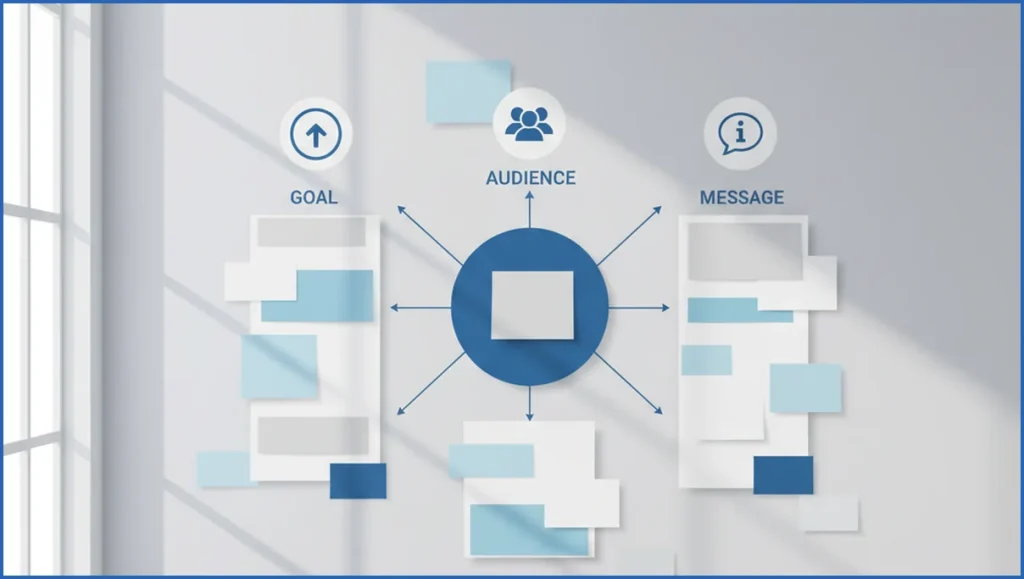
Set Goals, Audience, and Core Messaging
Start with one primary goal and two supporting metrics. For example, a B2B SaaS company may target 30 sales-qualified leads per quarter from organic content, with supporting metrics of 1,200 product page visits and a 2.5% visitor-to-lead rate. Those numbers force better choices than vague goals like brand awareness.
Next, define audience segments by pain point, not just job title. “Head of content at a 20-person SaaS team with no analyst support” is useful. “Marketer” is not. For B2B programs, a focused B2B SEO approach often sharpens ICPs, buying stages, and proof points.
Then write core messaging in plain language. Use a simple structure: problem, promise, proof. Example: “Your team ships content, but cannot tie it to pipeline. We connect search data, analytics, and briefs in one workflow. Proof comes from query-level reporting and assisted conversion trends.”
Choose Content Pillars and Formats That Fit
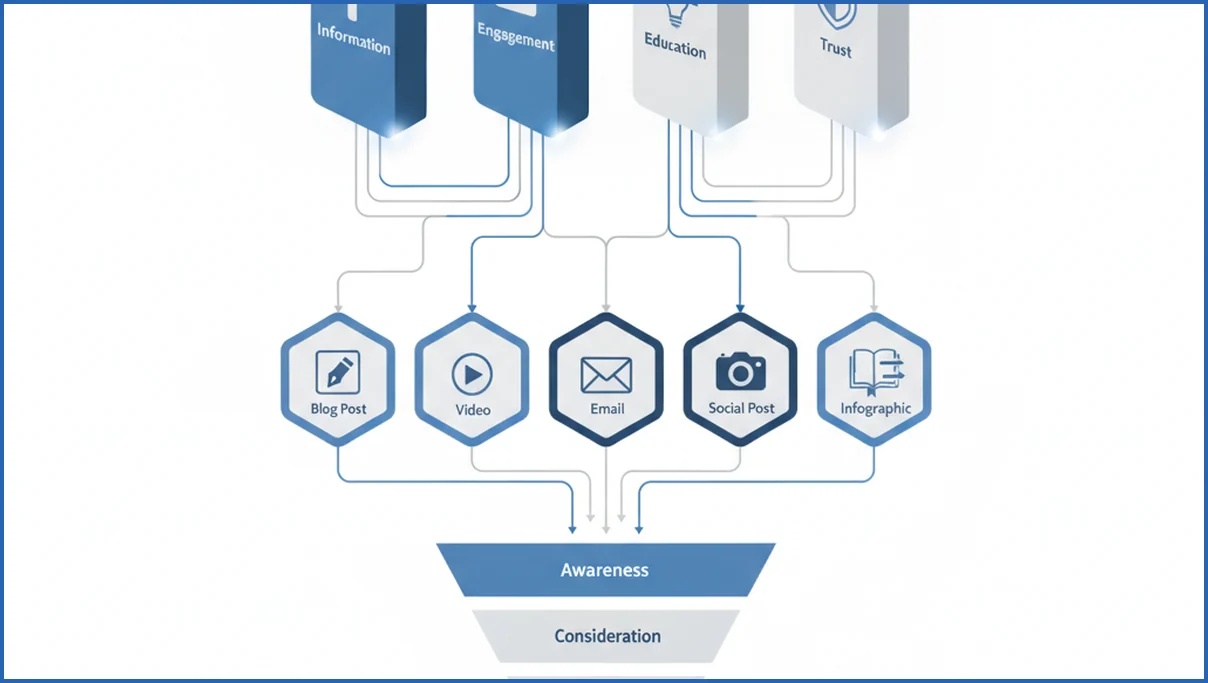
Content pillars are the few themes you want to be known for. Most teams need three to five. A CRM brand might choose pipeline reporting, sales automation, lead routing, and CRM migration. Those themes create repetition with purpose, which is how audiences remember you and search engines map relevance.
Formats should match intent. A comparison page works near decision. A short explainer video helps with awareness. A calculator or template can push consideration into action. If you need tooling support, this AI content generator comparison helps you pick formats and production methods without bloating the stack.
- Awareness: blog post, short video, newsletter essay
- Consideration: case study, webinar, detailed guide
- Decision: comparison page, ROI calculator, product-led email
Build a Simple Workflow for Planning and Production
Keep the workflow boring. Boring scales. One useful five-step system is topic intake, brief, draft, review, publish. Assign a single owner to each step and set a service-level target, like two days for briefs and three days for review. That alone removes most bottlenecks.
Here is a practical example using MCP tools. Pull rising queries from the Google Search Console MCP, then join landing page conversions from the GA4 MCP for Claude. Use the overlap to prioritize content that already shows demand and commercial signal.
1. Export queries with positions 6-20 and rising impressions
2. Match them to URLs with assisted conversions in GA4
3. Create or refresh briefs for pages with weak CTR or thin coverage
4. Publish updates every Tuesday and Friday
5. Review performance after 28 days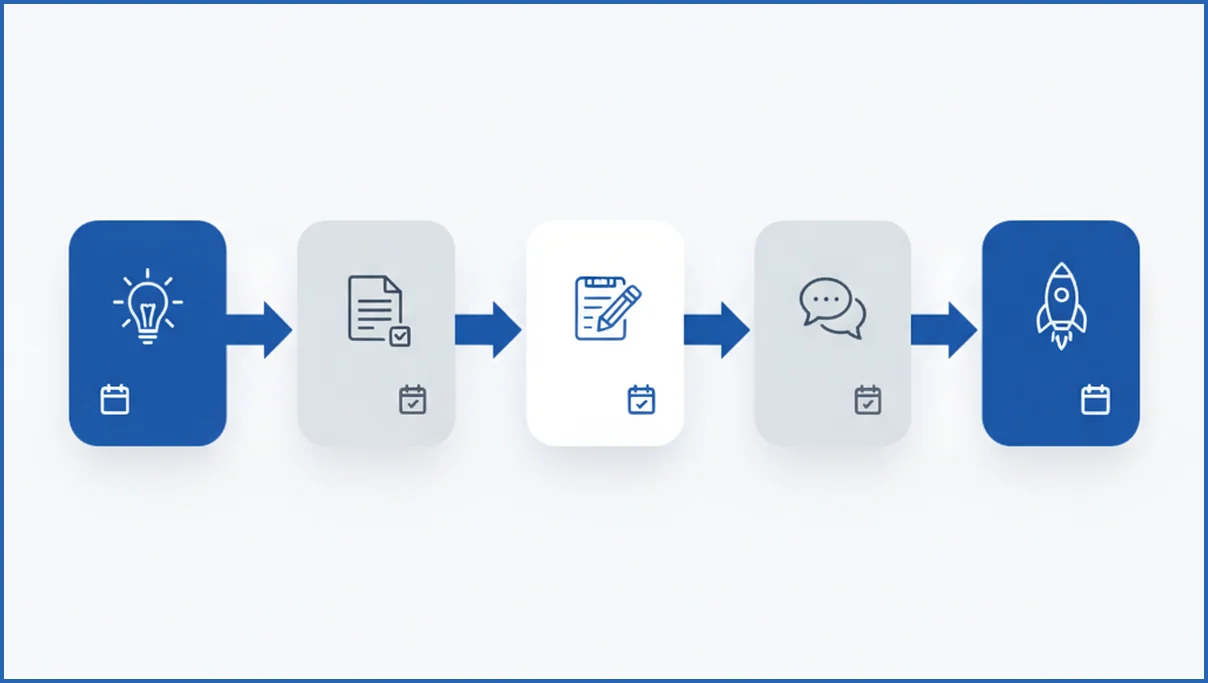
Distribute Content Where It Will Actually Get Seen
Publishing is the midpoint, not the finish line. Every asset needs a distribution plan across owned, shared, and earned channels. A blog post can become an email intro, three LinkedIn posts, one sales enablement asset, and an internal link target. If you ignore internal distribution, your internal linking strategy will stay weaker than it should.
Match channels to the asset. Original research can earn mentions. Product explainers belong in email and sales follow-ups. Opinion pieces often travel further on founder social than on a company blog alone. Teams adapting for AI search should also study how generative engine optimization works, because visibility now spreads beyond ten blue links.
Measure Performance and Improve the Strategy Over Time
Track three layers of performance: reach, engagement, and business impact. Reach includes impressions and non-brand clicks. Engagement includes time on page, scroll depth, return visits, or newsletter signups. Business impact includes assisted conversions, demo requests, influenced revenue, or sales cycle acceleration. Most teams overvalue the first layer because it is easy to screenshot.
Run a monthly review and a deeper quarterly review. Monthly, inspect pages with high impressions but low CTR, and pages with traffic but no conversion path. Quarterly, prune weak topics, merge overlapping posts, and double down on pillars that produce qualified demand. A strategy is working when fewer assets create more useful outcomes.
Mapping Content for Google, AI Answers, and Zero-Click Search
Content plans in 2026 work better when each asset has a clear search role. Some pages should win direct clicks from high-intent queries like “Ahrefs vs Semrush pricing.” Others should supply concise, trustworthy answers that can surface in AI summaries. A third group should support zero-click visibility through definitions, stats, comparisons, and step lists. When teams mix these roles together, pages often become unfocused and weaker across every surface.
A simple map helps. Create one column for discovery intent, one for answer intent, and one for conversion intent. Discovery pages target broader questions and category education. Answer pages cover exact subquestions with clean structure, short summaries, and scannable headings. Conversion pages handle demos, ROI, implementation, and objections. This is where answer engine optimization guidance becomes useful, because it forces tighter formatting and clearer evidence.
Use content clusters, but define the job of each page inside the cluster. For example, a hub on content strategy can link to pages on briefs, editorial workflows, distribution, and reporting. Add short answer blocks near the top, then expand with examples, screenshots, and expert insight lower on the page. In many cases, that structure helps both search engines and human readers understand what should be cited, summarized, or clicked.
How AI Mode Changes Content Discovery and Planning in 2026
Content Marketing Strategy in 2026: A Practical Planning Guide now has to account for AI-assisted discovery, not just blue links. Google AI Mode can synthesize answers, compare options, and suggest follow-up paths inside the results experience. That means your plan should map content to tasks, entities, and proof points, not only keywords. Google has framed AI Mode as a more exploratory search experience tied to Gemini capabilities (Google I/O 2025).
For planning, the biggest shift is this: one article may support several discovery surfaces at once. A strong page can rank traditionally, appear in AI Overviews, inform AI Mode responses, and still earn clicks from deeper comparison intent. Teams should document which assets answer broad questions, which assets support evaluation, and which assets convert. If you need a wider framework, review Google AI Mode basics alongside your editorial calendar.
- Build pages around complete questions, not isolated head terms.
- Add original evidence such as product screenshots, pricing context, expert commentary, and first-hand examples.
- Track impressions, assisted clicks, and branded lift, not only last-click sessions.
Frequently Asked Questions
How do I know if my content marketing strategy is working?
Look for movement in metrics tied to your actual goal, not just traffic. If the goal is pipeline, track assisted conversions, demo requests, and sales conversations influenced by content. Also watch efficiency. A healthy strategy usually improves output quality, shortens briefing time, and raises the share of content that contributes to leads or revenue within 60 to 90 days.
What should a content strategy include for B2B teams?
B2B teams need a clear ICP, buying-stage map, core messaging, content pillars, format choices, and a distribution plan tied to sales motion. Include proof assets such as case studies, comparison pages, and objection-handling content. It also helps to define handoffs with sales, because content often fails when marketing publishes assets that reps never use in live deals.
How often should a content marketing strategy be updated?
Review the strategy monthly at the metric level and quarterly at the structural level. Monthly checks catch distribution problems, content decay, and conversion gaps. Quarterly reviews are better for changing pillars, audience focus, or messaging. Update sooner if the product shifts, a major channel changes, or you enter a new market with different search behavior and buying triggers.
What is the difference between content strategy and content marketing?
Content strategy defines why content exists, who it serves, what themes matter, and how success is measured. Content marketing is the execution layer. It covers creation, publishing, promotion, and optimization. Strategy answers the logic behind the work. Marketing answers the delivery. Teams get into trouble when they do a lot of content marketing without a strategy that filters what deserves attention.
Which metrics matter most for content performance?
The answer depends on the page type and business model, but most teams should track qualified organic sessions, CTR, assisted conversions, lead quality, and influenced pipeline. For editorial pages, watch whether traffic progresses to product or commercial pages. For bottom-funnel pages, focus on conversion rate and revenue influence. High pageviews with weak downstream action usually signal misaligned intent.
Can a small business use the same strategy framework?
Yes, but with fewer moving parts. A small business can use one audience, three pillars, two core formats, and a monthly publishing cadence. The framework stays the same. The scope gets tighter. That simplicity often helps, because smaller teams cannot afford content that looks busy but produces nothing. Clear priorities beat a large calendar with thin execution.
Do I need different content for each channel?
No, but you do need channel-specific packaging. The core idea can stay the same while the format changes. A blog post might become an email summary, a short social thread, and a sales follow-up asset. Rewrite the hook, length, and call to action for each channel. Reposting the exact same asset everywhere usually underperforms because audience behavior changes by platform.
Pick one existing pillar, audit the last 90 days of content against conversions, and cut anything that does not support a clear business goal. That single exercise usually shows whether your strategy is real or just a calendar.
How should content be optimized for AI Overviews in 2026?
Optimize for AI Overviews by answering the main question early, then supporting it with specific evidence, clear headings, and original details. Use concise summaries, strong on-page structure, and consistent terminology. Add examples, tool names, screenshots, or first-hand observations when possible. For a broader framework, see this AI search optimization playbook. The goal is to be easy to summarize and still valuable enough to click.
What to prioritize next
A stronger content strategy in 2026 balances discoverability with usefulness after the click. Plan pages for distinct roles, update older assets with sharper answers, and add proof that AI systems can cite confidently. Teams that adapt early usually waste less production effort and learn faster from real search behavior. The goal is not to chase every feature. It is to publish content that performs across classic search, AI summaries, and evaluation journeys.