
Last updated: September 2026
SEO for Startups: A Zero-to-Rank Playbook works best when you treat search like product discovery, not publishing volume. Early-stage teams usually win by targeting a few painful, revenue-linked queries instead of chasing broad awareness terms. The goal is simple: earn qualified visits from people close to action. That requires tight positioning, landing pages with clear intent, and measurement that connects rankings to demos, trials, or pipeline using tools like Google Search Console MCP.
TL;DR
- Start with one clear audience and one revenue goal.
- Prioritize technical basics before publishing more content.
- Build topic clusters around high-intent startup keywords.
- Use simple tracking to prove what drives signups.
- Turn early wins into repeatable SEO systems.
Why SEO matters for startups
SEO fits startups because it compounds. One useful page can bring qualified traffic for 12 to 24 months, while paid spend stops the minute you pause budget. That matters when CAC is unstable and brand demand is still weak. A ranked comparison page, use-case page, or integration page can keep producing pipeline while the team works elsewhere.
It also sharpens positioning. When you map search demand, you see how buyers describe their problem, what alternatives they compare, and where intent turns commercial. That research often improves messaging across landing pages, sales decks, and onboarding. If your team is also adapting to AI search behavior, AI search optimization should sit beside classic rankings, not replace them.
Early-stage founders should not aim for topical domination. Aim for a handful of pages that match the product and the buying journey. A startup selling finance software does not need 200 blog posts. It needs the 15 pages that solve specific searches like “startup expense management software” or “bookkeeping software for seed-stage companies.”
Set your SEO foundation before you publish
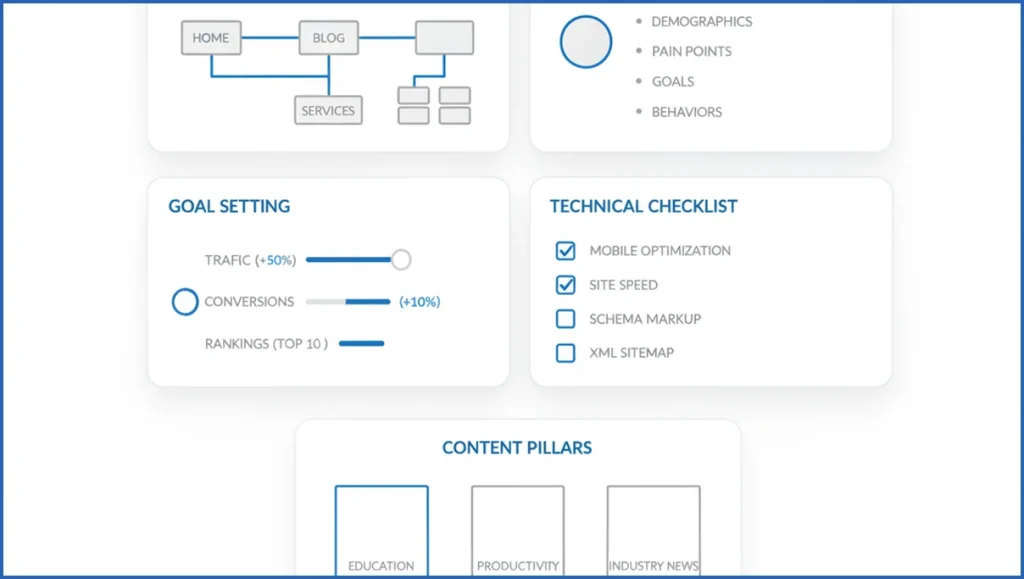
Start with one audience, one problem, and one conversion goal. If your ICP is B2B SaaS founders with 5 to 50 employees, say that plainly. Then build a site structure around product, use cases, comparisons, integrations, and supporting education. This is the same logic behind a strong content planning system.
Next, fix technical basics before volume. Make sure pages are indexable, titles are unique, canonicals are sane, mobile speed is acceptable, and internal navigation is simple. A five-page site with clean architecture beats a 70-page site with orphan pages and duplicate intent.
A practical starting structure looks like this: homepage, product page, three use-case pages, three competitor comparison pages, two integration pages, and a blog only if you can support it. Keep URLs short and descriptive. Put conversion paths on every key page, including demo, trial, or contact.
Find startup keywords with buying intent
Ignore vanity traffic at first. Look for keywords that signal action: software, tool, platform, service, pricing, alternative, comparison, template, integration. For a payroll startup, “payroll software for startups” is worth more than “what is payroll.” The first can convert this quarter. The second may not.
Use a simple scoring model: intent, business fit, difficulty, and evidence of product-led SERPs. Score each from 1 to 5. A keyword with 150 searches and a 19 difficulty score can beat one with 3,600 searches and a SERP full of giant brands. Keyword clustering helps turn that list into page groups instead of random articles.
Example workflow: pull Search Console queries, filter positions 8 to 20, then match them to pages you can improve. If a page ranks for 47 terms around “startup CRM for small teams,” expand sections, add proof, and tighten internal links. If you want faster analysis, the Google Search Console MCP can surface those near-win queries inside Claude.

Create pages that can rank and convert
Every startup needs a few page templates that do real work. Use-case pages capture category demand. Comparison pages catch bottom-funnel research. Integration pages attract technical buyers. Supporting blog posts can answer objections and link back into commercial pages.
Keep the structure plain. State who the page is for, what problem it solves, why your product fits, and what proof supports that claim. Add screenshots, pricing context, FAQs, and a visible CTA. If you want a tighter process, this on-page SEO workflow is close to how many lean teams ship pages quickly.
Here is a simple content brief format your team can reuse:
Primary keyword: startup invoicing software
Search intent: commercial investigation
Page type: product-led landing page
Sections:
1. What it is
2. Why startups need it
3. Key features
4. Startup pricing logic
5. Comparison vs spreadsheets
6. Customer proof
7. FAQ
CTA: Start free trial
Internal links matter more than most startup teams think. Link from educational pages into money pages with descriptive anchors. Avoid generic prompts. A post about SaaS finance ops should point to your startup accounting page, not just the homepage.
Build authority without a huge budget
Most startups do not need expensive link campaigns in month one. They need credibility assets. Publish original data, customer stories, integration guides, founder POV pieces, and helpful free tools. These earn mentions because they are useful, not because you blasted 500 cold emails.
Partnerships work well here. If you integrate with another tool, co-publish a setup guide and ask for a partner directory link. If customers use your product in a niche workflow, turn that into a case study. Teams building AI-heavy workflows can also use MCP-based tooling to package useful utilities that attract links from practitioners.
A lean weekly routine works: pitch three podcasts, ask two partners for co-marketing, publish one evidence-based asset, and reclaim unlinked mentions. Authority often grows from consistent proof, not clever outreach copy.

Measure early results and keep improving
Track four things first: indexed pages, non-brand clicks, rankings for target terms, and conversions from organic sessions. That is enough to show movement. Fancy dashboards can wait. If a page gets 120 visits and three demo requests, you already have a useful signal.
Review performance every month with a short checklist:
- Which pages gained impressions but not clicks?
- Which queries rank in positions 5 to 15?
- Which pages drive assisted conversions?
- What internal links or proof elements are missing?
Use Search Console for query movement and GA4 for conversions. The GA4 MCP tools can help pull landing-page conversion patterns without exporting endless spreadsheets. Then update titles, expand weak sections, tighten CTAs, and merge pages that overlap. SEO for startups improves through disciplined edits, not constant publishing.
How AI Mode and Google updates change startup SEO
Google now answers more searches directly, so startups cannot rely on blue-link rankings alone. AI Overviews and AI Mode reward pages that solve a narrow question fast, then support it with clear evidence. Google has also said its systems aim to surface helpful content from credible sources, not just pages with exact-match phrases. That means weak listicles lose ground, while product-led explainers, comparison pages, and original data often become more useful assets.
For startups, the playbook shifts from publishing more pages to publishing sharper ones. Build pages around buyer tasks, not broad topics. A page like “SOC 2 compliance for seed-stage fintech teams” can outperform a generic “cybersecurity guide.” Structure each page so an AI system can extract the answer quickly, then let a human continue deeper. If you need the larger search context, see Google AI Mode explained for the behavior changes affecting discovery.
- Lead with the direct answer in the first 100 words, then expand with proof, examples, and product fit.
- Use comparison tables, pricing details, screenshots, and founder or customer insight to add unique value.
- Track clicks, impressions, and assisted conversions by page type, because visibility may rise before traffic follows.
Frequently Asked Questions
How long does SEO take for a startup?
Most startups see early signals in 6 to 12 weeks, not full payoff. Indexation, impressions, and a few page-one moves often come first. Meaningful demos or trials from SEO usually take 3 to 6 months if the site is new. A startup with existing authority, clear product pages, and strong internal links can move faster than that.
Should startups focus on blog posts or landing pages first?
Landing pages usually deserve priority. They match commercial intent better and can convert earlier traffic into pipeline. Start with product, use-case, comparison, and integration pages. Add blog content once those pages exist and need support. Blog posts work best when they answer objections, target adjacent queries, or feed internal links into money pages.
What is the best SEO budget for an early-stage startup?
The right budget depends on team time more than a magic number. Many early startups can begin with founder input, one operator, and a modest tools stack. Others need outside help for technical fixes and content production. If you need a realistic benchmark, compare options with an SEO cost calculator before committing to retainers you cannot support.
Do startups need backlinks before ranking?
No, not always. Startups can rank for lower-difficulty and niche commercial terms with solid page quality, good internal linking, and clear topical focus. Backlinks matter more as competition rises. If your target SERPs are full of established domains, authority becomes a bigger constraint. Early on, relevance and specificity often beat raw domain strength.
Which SEO metrics matter most for startups?
Focus on non-brand clicks, rankings for target commercial terms, demo or trial conversions, and assisted revenue. Branded traffic can hide weak SEO performance, especially after launches or PR spikes. Track page-level outcomes, not just sitewide totals. A single comparison page that produces two sales conversations can matter more than a blog post with 2,000 casual visits.
Can a startup do SEO without hiring an agency?
Yes, if someone owns the process and the scope stays tight. A founder, marketer, or product-led operator can handle keyword selection, briefs, internal links, and monthly reviews. Agencies help when technical debt is high or execution is slow. If you want outside perspective without a long contract, a focused SEO consultation is often enough to set direction.
Pick 10 pages, not 100. Build them around one audience, one revenue goal, and clear search intent. Then review monthly and cut what is not working. That discipline is usually the difference between startup SEO that compounds and startup SEO that becomes an abandoned content folder.
How should startups optimize for AI Overviews in Google?
Start with pages that answer one high-intent question clearly, then support the answer with specifics. Add definitions, steps, comparisons, pricing context, and original proof. Use descriptive headings and short sections so systems can extract key points. Strengthen internal links between product, use-case, and educational pages. For a deeper framework, review AI search optimization and test which pages gain impressions in Search Console.
Next steps for startup SEO
Startup SEO is still about focus, but Google’s interface changes raise the bar for clarity and proof. The teams that win publish fewer vague pages and more useful assets tied to buyer problems. Build around intent, show evidence, and review performance every month. If you want a practical way to tighten priorities, book an SEO consultation and map the pages most likely to move revenue.