
Last updated: August 2026
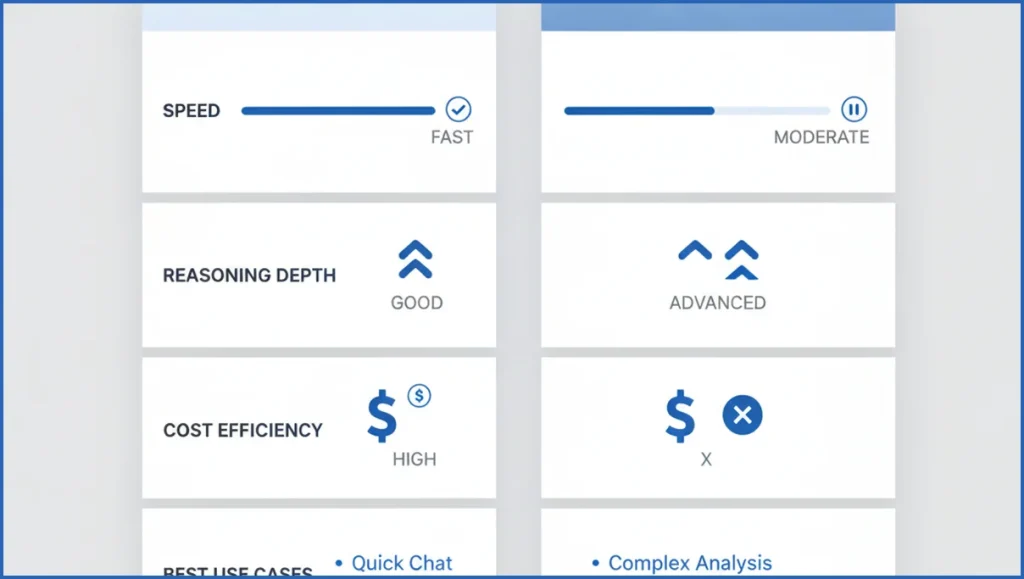
Claude Sonnet vs Opus: Which Model Fits Your Work? The fastest way to choose is to stop asking which model is “best” and start asking what failure costs you. If a slower answer saves a broken launch, Opus can pay for itself. If you need 50 usable outputs before lunch, Sonnet often wins. The latest Claude updates make that trade-off sharper, because Sonnet now handles more advanced work while Opus keeps its edge on harder judgment calls.
TL;DR
- Sonnet is usually the faster, more cost-efficient choice.
- Opus is stronger for harder reasoning and complex tasks.
- Both can write, code, and analyze; the fit depends on workload.
- Use Sonnet for volume, Opus for depth and high-stakes work.
Claude Sonnet vs Opus: the short answer
If you write briefs, summarize docs, cluster keywords, or draft code daily, Sonnet is the practical default. It handles most production work well enough, and it keeps spend under control. That matters when you run 50 prompts a day, not five.
Opus makes sense when wrong answers are expensive. Think multi-step debugging, difficult research synthesis, or strategic analysis across several inputs. For teams building AI-assisted SEO systems, Sonnet often powers the pipeline, while Opus reviews the hard edge cases. That split works especially well with Claude MCP setups and structured SEO workflows.
What actually differs between Sonnet and Opus
The main differences are reasoning depth, speed, and price. Sonnet usually responds faster and costs less, so it fits repetitive work. Opus tends to hold more nuance across long tasks and follow complex instructions more carefully, especially when the prompt has multiple constraints.
Output quality also differs by task shape. On a 1,200-word article draft, both can produce clean prose. On a messy analytics question with conflicting evidence, Opus is more likely to sort the signal from the noise. If your work depends on source reconciliation, this matters more than raw eloquence.
Performance by use case: writing, coding, analysis, and research
For writing, Sonnet is often enough. It can draft landing pages, rewrite intros, and turn outlines into publishable copy. If your team already has a style guide, Sonnet usually hits the brief faster. For repeatable editorial systems, pair it with an AI blog writing workflow and keep humans on final review.
Coding is more split. Sonnet handles short scripts, regex cleanup, and content ops automation well. Opus is better when the bug spans files or the logic is nested. A simple example:
# Task: group GSC queries by intent and URL overlap
# Good Sonnet job: clean CSV, cluster phrases, output JSON
# Better Opus job: debug clustering logic across 3 scripts
python clean_gsc.py
python cluster_queries.py --min-overlap 0.35
python export_brief.py
For analysis and research, Opus usually has the edge. Give it GA4 trends, GSC drops, and a notes file from sales calls, and it is more likely to form a coherent hypothesis. That is useful if you already use the GSC MCP endpoint or combine sources in answer-engine work like answer engine optimization.

Cost, limits, and efficiency: is Sonnet cheaper than Opus?
Yes, Sonnet is generally the cheaper option. Exact pricing and limits can change, so check Anthropic directly before you model costs. Still, the buying logic stays the same. If your task succeeds with 85 to 90 percent accuracy on the first pass, Sonnet often delivers the best value.
Efficiency is not just token price. It is cost per useful output. If Sonnet needs two retries and Opus gets the answer right once, the premium can be worth it. For SEO teams managing budgets across tools, this is the same logic behind SEO cost planning and tool stack discipline.
Which is better: Opus 4 vs Sonnet 4?
Opus 4 is better when your prompt asks for deeper reasoning, tighter judgment, or more careful synthesis. Sonnet 4 is better when throughput matters. That includes content production, prompt chains, bulk classification, and assistant features inside internal tools.
A clean rule is this: if you would pay a senior strategist to double-check the output, use Opus. If you would hand the task to a skilled coordinator with a checklist, use Sonnet. Teams building AI content systems can see this split clearly in automated content brief workflows.

Decision guide: choose Sonnet or Opus in 30 seconds
Use this simple filter when you pick a model:
- Choose Sonnet if the task is repeatable, time-sensitive, or high-volume.
- Choose Opus if the task has ambiguity, multiple sources, or business risk.
- Start with Sonnet, then escalate failed or high-value cases to Opus.
That routing model is usually better than forcing one model across everything. It cuts spend without dragging quality down. It also fits mixed stacks, especially if you run keyword clustering, briefs, and audits through AI SEO tooling and reserve premium calls for final judgment.
What’s new in Claude Sonnet and Opus right now
Anthropic’s current split is clearer than it was a year ago. Claude Sonnet is positioned as the fast, broadly capable workhorse. Claude Opus remains the premium option for deeper reasoning, longer problem solving, and tougher edge cases. The practical update is not just raw quality. It is how reliably each model handles sustained multi-step work, coding, and tool use inside real workflows.
Recent Claude releases also put more emphasis on agent-style tasks and connected tools, which matters if you use Claude beyond chat. In many cases, Sonnet now covers research, drafting, debugging, and analysis that once pushed teams toward Opus. Opus still tends to justify itself when output errors are expensive, context is messy, or instructions require more judgment. If you are building connected workflows, this matters even more with Claude MCP integrations that let Claude pull live data into the task.
- Sonnet is usually the better default for speed, throughput, and cost control.
- Opus is still the stronger pick for high-stakes reasoning, nuanced writing, and complex code review.
- The latest gap is more about consistency under pressure than basic competence.
Frequently Asked Questions
Is Opus 4.5 better than Sonnet?
Usually yes, if your definition of better is deeper reasoning and stronger performance on difficult prompts. That does not mean it is the right default. For short writing tasks, content cleanup, or routine classification, Sonnet may still be the smarter choice because it returns good outputs faster and at lower cost.
Which is better Claude Opus 4 or Claude Sonnet 4?
Opus 4 is stronger for complex problem-solving, careful synthesis, and tasks where one mistake can waste hours. Sonnet 4 is stronger for day-to-day production. If your workflow includes many repeated prompts, Sonnet usually gives better overall efficiency. If your workflow includes thorny judgment calls, Opus is the safer pick.
Is Claude Sonnet cheaper than Opus?
Yes. Sonnet is generally priced below Opus, which is why many teams use it as their baseline model. The real question is not only sticker price, though. Compare how often each model needs retries, edits, or manual correction. A cheaper call can become expensive if it creates rework downstream.
When should I use Sonnet instead of Opus?
Use Sonnet for drafting, summarizing, extraction, tagging, keyword grouping, outline generation, and basic code assistance. It also fits internal tools that need responsive output. If the task has a clear structure and a known format, Sonnet is often enough. Save Opus for cases where ambiguity and consequences are both high.
Is Opus worth the extra cost for coding?
It depends on the coding task. For shell scripts, content transformations, and small automations, Sonnet often covers the job. Opus becomes worth it when you debug across files, trace subtle logic failures, or design architecture with trade-offs. The more hidden complexity the codebase has, the more the premium can make sense.
Can Sonnet handle complex reasoning tasks?
Yes, within limits. Sonnet can handle plenty of multi-step work if the prompt is well-structured and the context is clean. It struggles more when evidence conflicts, requirements stack up, or the task needs careful judgment. A good pattern is to let Sonnet produce the first pass, then send edge cases to Opus.
If you are deciding for a real workflow, do not debate in the abstract. Test both models on 10 of your own tasks, measure edit time, and keep the winner per task type. That is usually more useful than any generic benchmark.
What’s the latest difference between Claude Sonnet and Opus?
The latest difference is mostly about operating style, not basic usefulness. Sonnet is the faster and more economical model for everyday production work. Opus is still stronger when prompts are ambiguous, high-stakes, or reasoning-heavy. In many cases, Sonnet now covers tasks that once needed Opus, but Opus remains the safer choice for harder reviews, deeper synthesis, and complex problem solving. For broader visibility strategy, see answer engine optimization.
Final verdict
Most teams should start with Sonnet, then escalate selected tasks to Opus when quality risk rises. That setup usually gives the best balance of speed, cost, and reliability. If you are comparing models inside larger search or content systems, map them to task tiers rather than choosing one for everything. For planning that broader mix, our AI content generator comparison can help frame where each tool actually fits.