
Last updated: August 2026
AI content editing works well when you treat it like a fast second set of eyes, not a final editor. It can spot repetition, flatten awkward sentences, and suggest stronger structure in seconds. Still, weak claims, brand drift, and factual errors slip through unless you use a checklist. That is the difference between faster publishing and faster mistakes.
TL;DR
- Use AI to speed up editing, not replace judgment.
- Check clarity, accuracy, tone, and structure in order.
- Apply a repeatable checklist before every publish.
- Keep human review for facts, nuance, and brand voice.
Why AI content editing still needs a human checklist
AI is good at local fixes. It can shorten a 32-word sentence, remove duplicate ideas, and flag stiff phrasing. It is worse at deciding whether a claim sounds credible to your market. That matters in SEO, where trust affects links, conversions, and how content holds up against answer engine optimization patterns.
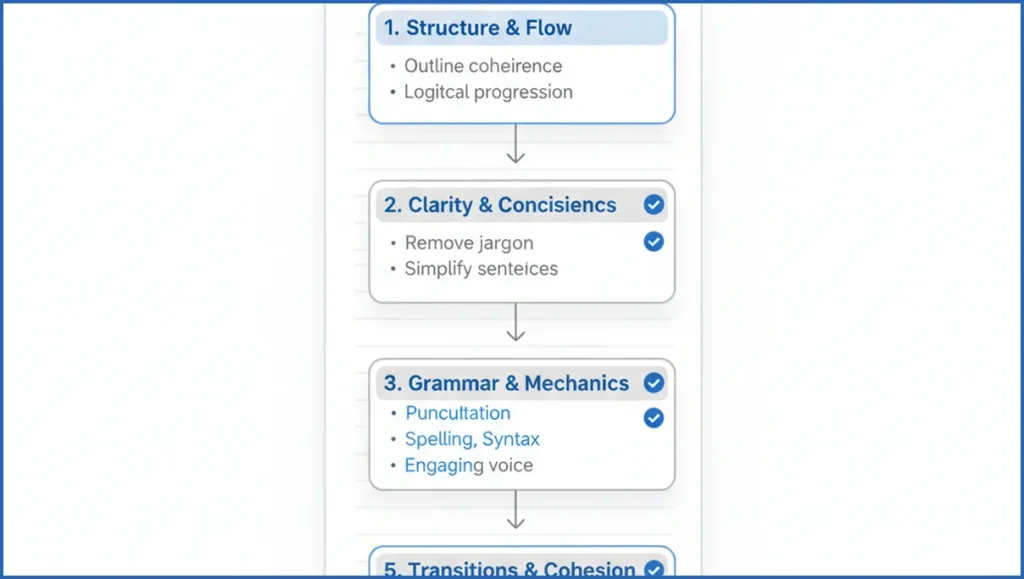
A checklist gives the model boundaries. You stop asking for “improve this” and start asking for specific passes: structure first, clarity second, facts third. That order cuts noise. It also prevents the common failure mode where AI rewrites a paragraph beautifully but changes the meaning.
Set your editing goals before you ask AI to help
Start with four inputs: audience, page goal, tone, and success metric. A founder memo, product landing page, and comparison post need different edits. If the goal is demo requests, your AI should tighten objections and CTA flow. If the goal is rankings, it should protect query intent and topical coverage.
Give the model a compact brief before the draft. A simple prompt works: “Edit for SaaS buyers with intermediate SEO knowledge. Keep a direct tone. Preserve all product names. Improve clarity, cut fluff, and do not add claims.” Teams building repeatable systems often pair this with a documented AI copywriting workflow so every editor uses the same guardrails.
Run the core AI content editing pass
Use one sequence every time. First, ask AI to assess structure: missing sections, weak ordering, thin examples. Second, run a clarity pass for long sentences, vague nouns, and hidden assumptions. Third, check grammar and transitions. Last, trim repetition and read for rhythm.
A practical workflow looks like this:
- Summarize the article in 5 bullets.
- List sections that do not support the main intent.
- Rewrite only the weakest 3 paragraphs.
- Flag sentences above 24 words.
- Suggest 3 stronger transitions between sections.
If you want measurable edits, connect the draft to performance data. Editors using the Google Search Console MCP can review queries in positions 8-12, then ask AI to sharpen passages that already earn impressions but weak clicks.
Edit this draft in 4 passes:
1. Structure issues only
2. Clarity rewrites only
3. Grammar and repetition only
4. Final readability score estimate with 5 problem sentences
Check accuracy, originality, and brand consistency
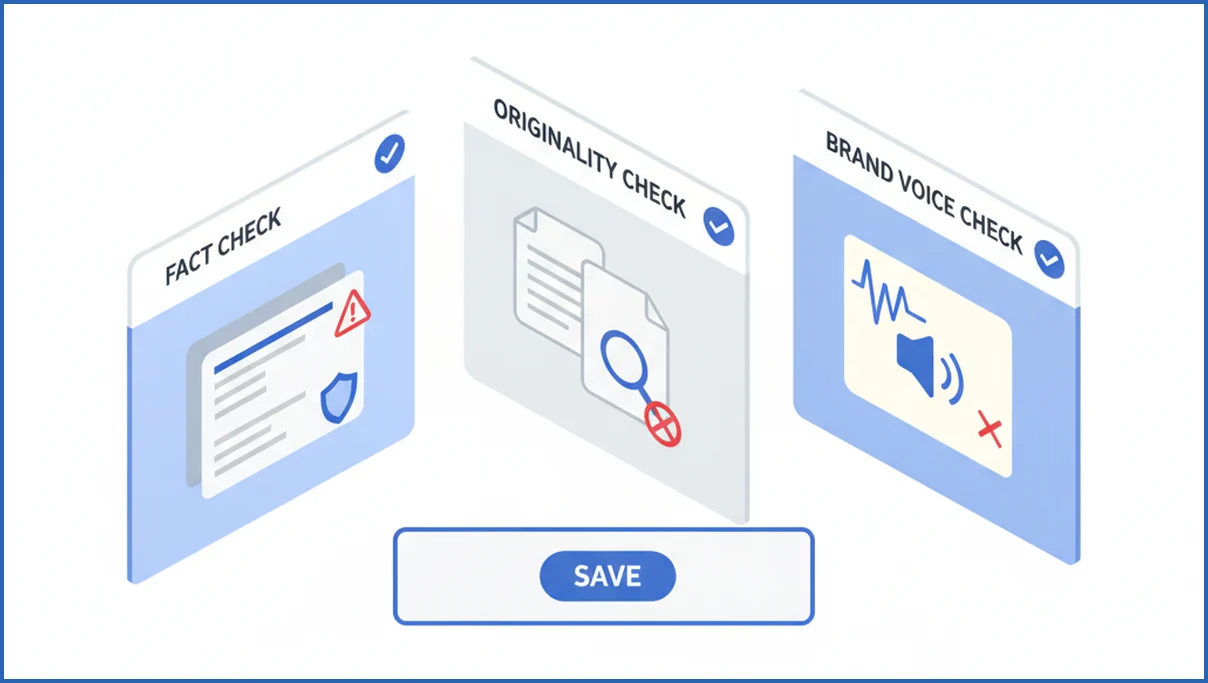
Do not mix fact-checking with style review. Handle facts first. Ask AI to extract every claim with numbers, dates, names, and product references into a list. Then verify each one manually. This is especially useful when editing topics tied to Google AI Mode changes, where details shift fast.
Originality needs a separate pass. AI often defaults to padded intros, soft verbs, and broad claims. Replace generic lines with specifics: “47 pages lost clicks after the title rewrite” beats “performance declined.” Brand consistency is similar. Lock in terms, spelling, banned phrases, and point of view before the rewrite starts.
Use AI prompts to tighten headlines, intros, and CTAs
Most lift comes from the top and bottom of the page. Headlines affect clicks. Intros affect bounce. CTAs affect action. Ask AI for constrained options, not unlimited ideas. Example: “Write 10 headlines under 60 characters. Keep the phrase AI content editing. Avoid curiosity bait.”
For intros, ask the model to cut throat-clearing and state the payoff by sentence two. For CTAs, tie the next step to the reader’s current problem. If your article supports a broader content marketing strategy, the CTA should move readers to the next asset, not just repeat a sales pitch.
Rewrite this intro in 80 words.
Keep the main claim.
Remove generic setup.
Make sentence 1 specific.
Make sentence 2 explain the payoff.
Create a repeatable pre-publish workflow
Good editing systems reduce variance. Use a shared checklist with named stages: AI pass, factual review, brand review, SEO review, and final human signoff. Version each stage. That makes it easier to learn which edits improve engagement and which ones just make the draft look cleaner.
A lean pre-publish stack can live in a doc, spreadsheet, or Claude MCP workflow. What matters is consistency. If one editor checks claims and another skips them, your output quality will swing. Keep the checklist short enough that people actually use it.
Frequently Asked Questions
What is AI content editing?
AI content editing is the use of language models to review and improve an existing draft. It usually covers structure, clarity, grammar, repetition, tone, and readability. The useful distinction is that editing starts with a draft that already has a goal. You are refining it, not asking AI to invent the whole page from scratch.
Can AI edit content better than a human?
AI beats humans on speed and pattern spotting. It can find duplicate phrasing or clunky transitions across 2,000 words in seconds. Humans still win on judgment. They know when a claim sounds risky, when a sentence carries the wrong implication, or when a brand should sound restrained instead of clever. Strong teams combine both.
How do I prompt AI for better edits?
Be narrow and staged. Tell the model the audience, goal, and constraints, then ask for one pass at a time. “Fix clarity only” works better than “make this better.” You should also tell it what not to change, such as product names, statistics, or quoted language. Specific prompts reduce unwanted rewrites.
What should AI never edit without review?
Do not let AI publish changes to facts, legal claims, medical guidance, pricing, customer quotes, or compliance language without a human check. The same rule applies to strategic positioning statements. These sections carry risk if wording shifts slightly. AI can suggest improvements, but a person should approve the final version line by line.
How do I keep AI-edited content on brand?
Create a short brand editing sheet. Include approved terms, banned phrases, sentence style, reading level, and examples of what “sounds like us” versus what does not. Paste that into the prompt before every edit. If you manage multiple products or regions, build separate profiles. One generic brand prompt rarely holds up across teams.
Does AI content editing help SEO?
Yes, when it improves search intent match, clarity, internal linking, and scannability without damaging accuracy. Cleaner intros and headings can help engagement. Better structure can help topical coverage. Still, AI editing does not rescue weak research or poor positioning. SEO gains come from better pages, not from the presence of AI itself.
What is the best workflow for AI editing?
The most reliable workflow is sequential: define the goal, run a structure pass, run a clarity pass, verify facts, check brand voice, then do final human approval. Keep each step visible in a checklist. If possible, compare edited pages against click-through rate, scroll depth, or conversion rate after publishing to learn what actually helped.
If you only change one thing, stop doing one-shot “improve this” prompts. Split your ai content editing into ordered passes, and track which pass catches the most issues. That single shift usually cleans up drafts faster than switching models.