
Last updated: July 2026
AI ad copy is useful when you treat it like a fast junior copywriter, not an autopilot. It can turn one campaign brief into 20 angles, six CTA styles, and platform-specific variants in minutes. The win is speed with structure. The risk is generic language, weak claims, and policy problems if you skip the edit.
TL;DR
- Use AI to draft faster without losing brand voice.
- Turn one brief into many testable ad angles.
- Edit for clarity, compliance, and conversion.
- Measure results to improve each new iteration.
What AI Ad Copy Can Do for Modern Marketers
Good AI ad copy shortens the slow part of paid media. You feed it an offer, audience, proof point, and tone. It returns headline options, primary text, CTA variations, and rewrites for Meta, Google, and LinkedIn. That matters when one launch needs 15 to 30 assets by Friday.
It also helps teams test ideas they usually skip. A marketer can compare fear-of-missing-out language against pain-point framing, or benefit-led copy against proof-led copy. That same thinking shows up in practical AI copy workflows and works just as well for ads.
Still, AI is bad at context unless you supply it. It will invent urgency, flatten your brand voice, and overuse cliches. If you want stronger systems around prompts and outputs, this tool comparison is a useful baseline for what different generators do well.
Set the Right Inputs Before You Prompt
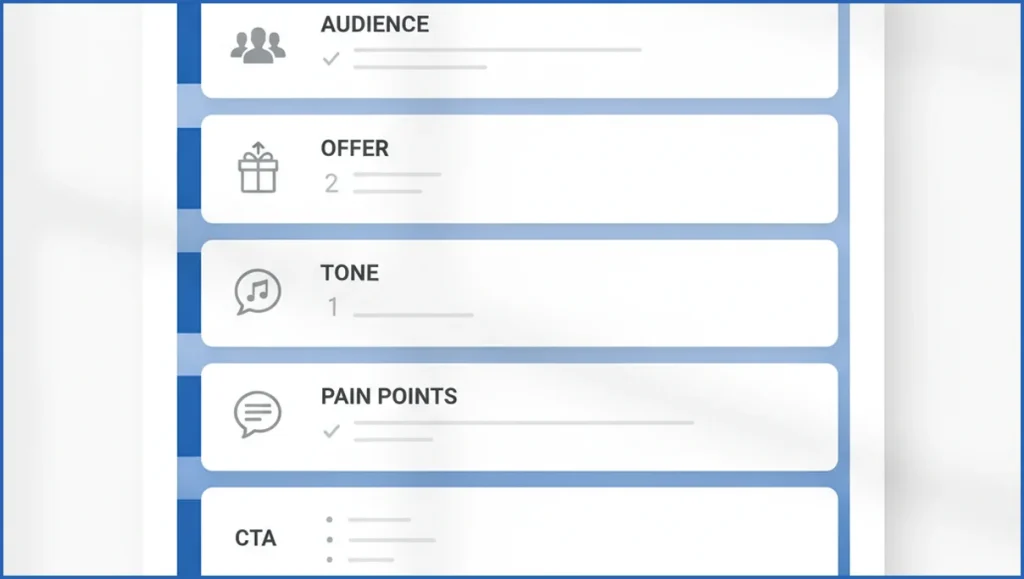
Start with five fields: audience, offer, pain point, proof, and constraint. “B2B SaaS founders” is too broad. “Founders at 5 to 50 employee SaaS firms, struggling with slow lead follow-up” gives the model something to work with. Add the actual offer, such as a 14-day trial or free audit.
Then define tone and limits. For example: plain English, no hype, no medical or financial claims, headline under 40 characters, and one CTA per variant. If your team already uses structured briefs from automated content brief systems, reuse that format for ads.
Write Prompts That Generate Stronger Ad Variations
Ask for structured outputs, not “write me ads.” A better prompt names the channel, angle, audience, and copy slots. Example: write 10 Google Ads headlines under 30 characters for a GA4 reporting tool. Focus on faster weekly reporting. Avoid saying “best” or “guaranteed.”
Use prompt blocks for each asset type. One block for headlines, one for primary text, one for CTA, and one for policy checks. Teams building connected AI systems through MCP workflows for Claude can pass campaign data straight into these prompt templates.
Create 6 Meta ad variants.
Audience: ecommerce managers at stores doing $50k-$500k monthly revenue.
Offer: free audit of wasted ad spend.
Tone: direct, credible, specific.
Include:
- 1 headline under 40 characters
- 1 primary text under 125 characters
- 1 CTA
Angles:
1) wasted budget
2) weak tracking
3) missed remarketing revenue
Avoid hype, all caps, and unverifiable claims.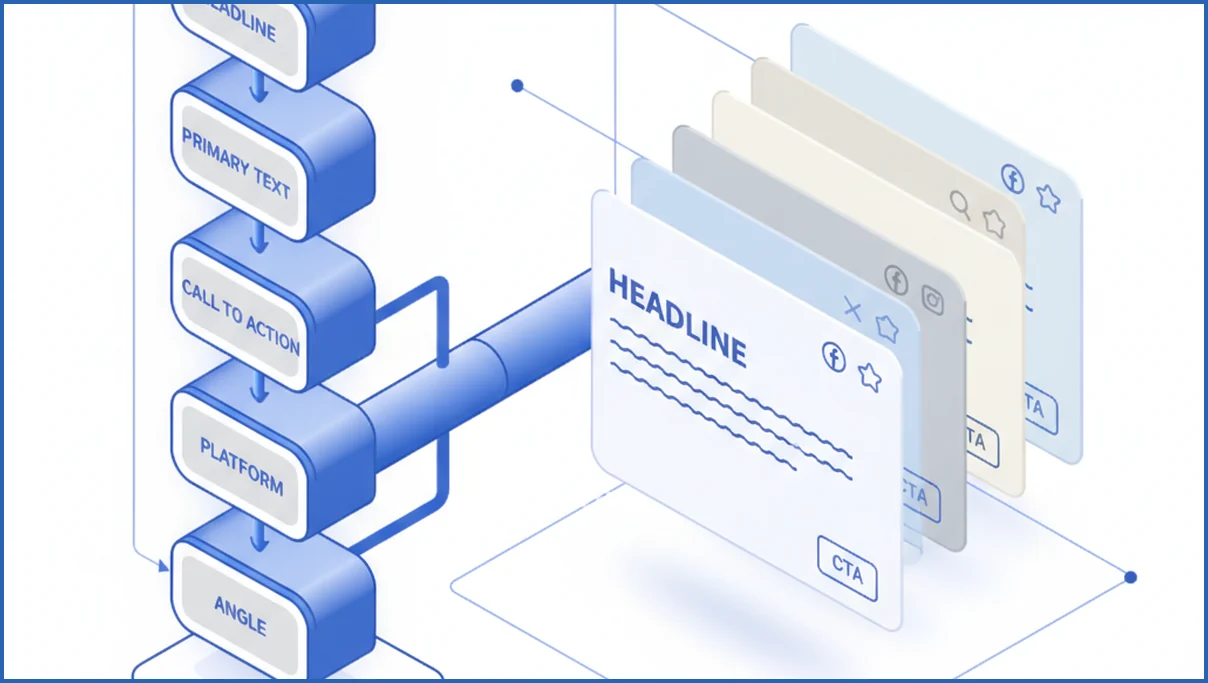
Edit AI Drafts for Brand Voice and Compliance
First pass editing is subtraction. Cut filler, repeated benefits, and fake urgency. Replace “transform your workflow” with a claim you can support, such as “build weekly reports in 12 minutes.” Numbers force clarity.
Next, check policy and tone. Meta and Google dislike misleading claims, personal attribute assumptions, and exaggerated outcomes. If your brand voice is calm and technical, keep sentence rhythm tight and specific. A documented content strategy helps here because voice rules stop ad copy from drifting.
Test AI Ad Copy Against Real Performance Data
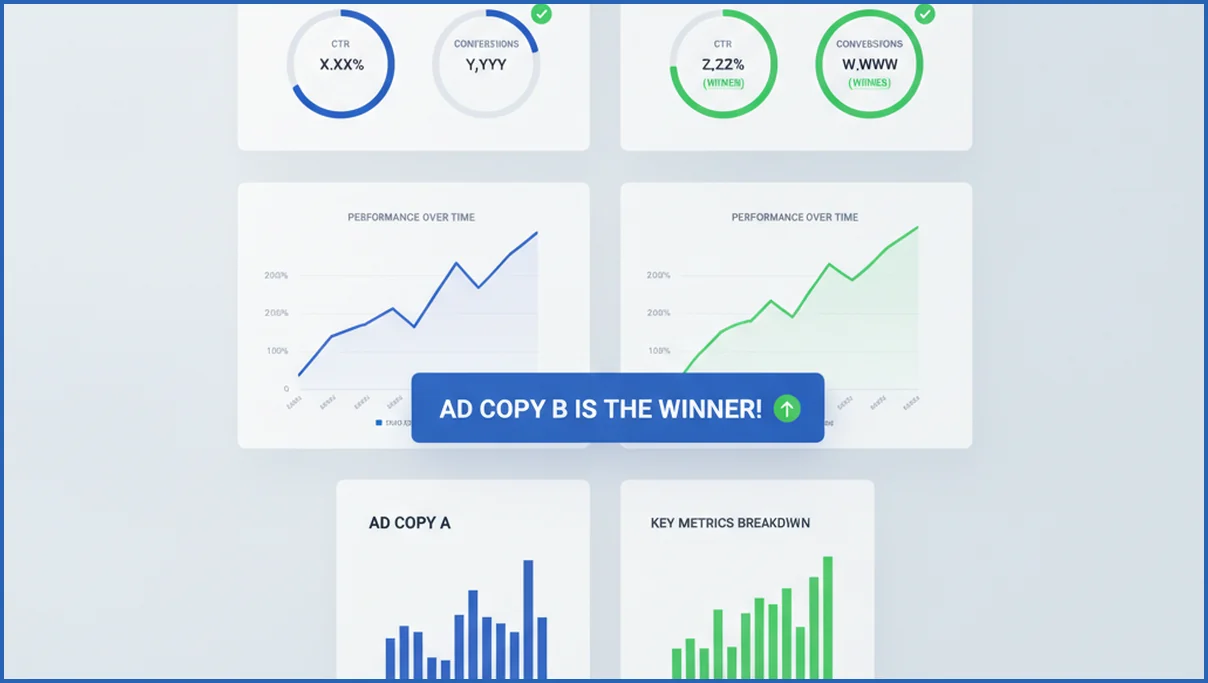
Do not judge copy by taste alone. Test one variable at a time when possible: hook, offer framing, or CTA. If three ads use the same audience and creative, then differences in CTR, CPC, and conversion rate tell you something useful.
A simple example: Variant A says “Cut wasted spend.” Variant B says “Find missed revenue.” After 18,000 impressions, A gets 1.9% CTR and 14 conversions. B gets 1.2% CTR but 19 conversions. B may be the better copy if CPA holds. This is where GA4 MCP reporting can help pull clean post-click data into your review loop.
Build a Repeatable AI Ad Copy Workflow
The repeatable version is simple. Keep a prompt library, a brief template, a brand voice sheet, and a test log. Then each campaign starts from known inputs instead of a blank box.
- Collect audience, offer, proof, and constraints.
- Generate angle-based variants by platform.
- Edit for tone, claims, and policy safety.
- Launch controlled tests and log outcomes.
- Feed winners back into the next prompt set.
That loop gets stronger over time. Teams that already think in systems, like those planning for AI marketing agents, usually adapt to this fastest because they store decisions, not just drafts.
Frequently Asked Questions
Can AI write ad copy that sounds human?
Yes, but only after you give it real constraints and then edit the draft. Human-sounding ads usually have sharper specificity, cleaner rhythm, and fewer filler phrases. Give the model examples of your existing ads, banned phrases, target audience language, and character limits. Then cut anything vague or overblown before launch.
What inputs improve AI ad copy quality the most?
The biggest lift comes from clear audience definition, a single offer, one main pain point, and a proof point with numbers. Platform constraints also matter a lot. A prompt with “LinkedIn, CFO audience, webinar signup, formal tone, headline under 70 characters” will outperform a generic request almost every time.
How do I keep AI ads on brand?
Create a short voice sheet with examples. Include preferred tone, sentence style, banned claims, and words you never use. Ask the model to match that sheet, then review outputs against it. If your team has multiple approvers, turn those rules into a checklist so every ad gets the same standard instead of subjective feedback.
Which ad metrics matter most for testing copy?
Start with CTR for hook strength and conversion rate for message quality after the click. Then watch CPC, CPA, and impression-to-conversion volume before deciding a winner. High CTR alone can mislead you. Copy that attracts curious clicks but weak buyers often looks good early and performs worse once spend scales.
Can AI help with different ad platforms?
Yes. It is especially useful for adapting one message into Google Search headlines, Meta primary text, LinkedIn sponsored posts, and short display variations. Each platform needs different lengths and tone. Ask for channel-specific outputs rather than one universal ad. Otherwise the copy usually lands in the bland middle and underperforms everywhere.
How much editing should AI ad copy need?
Usually 20 to 40 percent of the draft needs work. Strong prompts reduce that, but final editing still matters for claims, brand fit, clarity, and repetition. If you find yourself rewriting everything, the problem is upstream. Tighten the brief, add examples, and ask for fewer variations with better-defined angles.
Next step, build one shared prompt template and test it on a single campaign with three angles. If the team cannot explain why one variant won, the workflow is still too loose.