

Last updated: July 2026
A good ai content audit does more than flag old posts. It shows where traffic is slipping, where pages overlap, and where weak content creates brand or compliance risk. Done well, AI cuts the sorting work so your team can spend time on better decisions. That matters now, especially as search gets messier and visibility spreads across classic rankings, AI answers, and product-led journeys.
TL;DR
- Map your content inventory before you audit anything.
- Use AI to detect gaps, duplication, and weak pages faster.
- Score content by impact, effort, and business priority.
- Turn audit findings into a clear refresh and removal plan.
Why an AI Content Audit Matters Now
Manual audits break once a site has 300 URLs, three authors, and mixed intent. You miss decaying pages, near-duplicates, and thin posts that still get indexed. AI helps by classifying patterns fast, then handing humans a shorter list of pages that need judgment.
Search has also changed shape. A page can lose clicks while keeping impressions. Another can rank for 47 queries in positions 8-12 and only need a stronger brief. If you already track AI search shifts with AI search optimization workflows, an audit gives you the page-level cleanup plan behind that strategy.
For lean teams, speed is the real win. Pull Search Console, analytics, and URL metadata into one sheet, then let AI tag intent, freshness, overlap, and risk. If your stack runs on Claude plus tooling, MCP servers for SEO data collection make that much easier.
Build Your Content Inventory and Audit Criteria
Start with a full URL inventory. Include blogs, landing pages, docs, templates, and old campaign pages. Add columns for title, index status, sessions, clicks, impressions, conversions, backlinks, last updated date, primary topic, and owner.
Next, define your audit rules before you prompt any model. Good criteria usually include search demand, business relevance, originality, topical overlap, content depth, factual accuracy, and conversion support. Teams that skip this step end up with tidy labels and bad decisions.
A simple starter framework works well: quality score out of 5, performance score out of 5, and risk score out of 5. Pull traffic and query data from the Google Search Console MCP endpoints and behavioral signals from your GA4 MCP setup. Then review a 30-page sample by hand before scaling the prompt across the whole inventory.
Use AI to Classify Content by Performance and Risk
Once the sheet is clean, ask AI to tag each URL by intent, funnel stage, topic cluster, and likely action. It should also flag pages with stale dates, weak originality, cannibalization, and compliance concerns. That gives you triage, not final truth.
Here is a practical prompt pattern: pass title, H1, meta description, top queries, traffic trend, and word count. Ask for JSON output with fields for topic_cluster, duplicate_risk, content_decay, brand_risk, and recommended_action. If you need cleaner topical grouping first, pair this with keyword clustering in Claude Code.
{
  "url": "/pricing-guide",
  "topic_cluster": "seo pricing",
  "duplicate_risk": "medium",
  "content_decay": "high",
  "brand_risk": "low",
  "recommended_action": "refresh"
}
One useful example: five articles target the same “SEO pricing” intent but split clicks across them. AI can spot query overlap and weak differentiation in minutes. Human review then decides whether one page becomes the canonical guide and four pages support or redirect into it.

Prioritize What to Refresh, Merge, Keep, or Remove
Not every weak page deserves a rewrite. Use a simple score: impact x business priority x ease. A page with 12,000 impressions, position 9.4, and outdated examples often beats a dead post with no links and no conversions.
Keep four action buckets only: refresh, merge, keep, remove. Refresh pages with demand and decent signals. Merge overlapping pieces that confuse both users and search engines. Remove thin, obsolete, or off-strategy pages that add index noise. If your broader plan still needs shaping, a practical content strategy framework helps tie audit actions to pipeline goals.
Turn Audit Insights into an Update Workflow
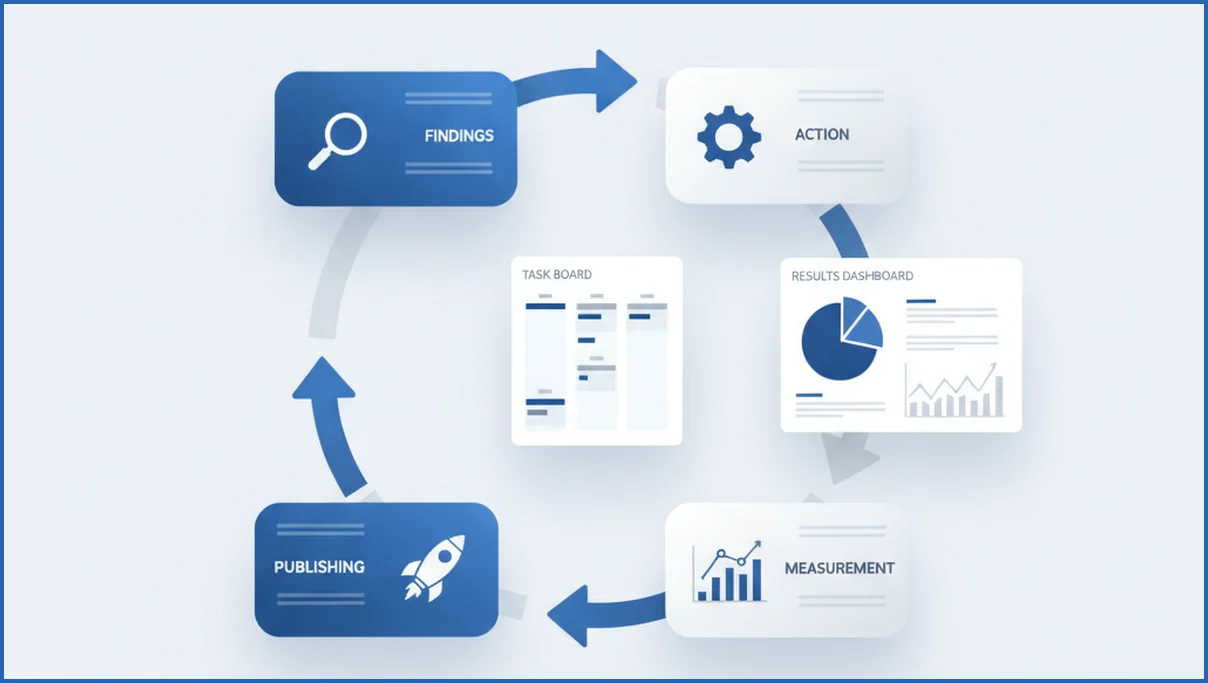
An audit fails when findings stay in a spreadsheet. Turn each action into a task with owner, due date, brief, source URLs, and success metric. For refreshes, include target queries, missing subtopics, weak claims to verify, and internal links to add.
Use a lightweight sequence:
- Export flagged URLs and assign action types.
- Create briefs for refresh or merge tasks.
- Update content, then run fact and brand review.
- Republish, request recrawl if needed, and annotate reporting.
- Check impressions, clicks, conversions, and assisted revenue after 14, 30, and 60 days.
For example, a B2B SaaS team refreshed 18 decaying pages first, not all 200. They reused one prompt template, one editor checklist, and one reporting view. If you want the content production side to match the audit side, an AI copywriting workflow for teams is the right companion process.
Common AI Content Audit Mistakes to Avoid
Bad inputs create confident nonsense. If your export misses noindex pages, canonical targets, or recent performance windows, AI will still classify them. It just will not classify them well. Clean data beats clever prompting every time.
Another mistake is treating AI output as final judgment. Models can miss nuance, legal risk, and SERP context. Use them to compress review time, not replace editors and SEOs. Teams working through how MCP-based workflows actually work usually get better results because the data path is clearer from the start.
Frequently Asked Questions
What is an AI content audit?
An AI content audit is a review process where AI helps analyze site content at scale. It can tag topics, detect duplicates, spot outdated pages, and summarize likely actions. The useful part is speed. The essential part is still human review, especially for brand fit, search intent, and factual accuracy.
How often should you run a content audit?
Most teams should run a light audit quarterly and a deeper audit once or twice a year. Sites that publish weekly, depend on organic leads, or operate in regulated spaces may need monthly checks on high-value pages. Frequency should match publishing volume, business risk, and how quickly search demand shifts in your category.
Can AI replace manual content review?
No. AI is good at sorting, summarizing, and spotting patterns across hundreds of URLs. It is weaker at nuance, legal judgment, and understanding whether a page truly serves the customer. Manual review should stay in the loop for final action decisions, high-risk content, and any page tied directly to revenue.
What data should feed an AI content audit?
Use URL, title, H1, meta description, word count, publish date, last updated date, index status, canonical, clicks, impressions, average position, sessions, conversions, backlinks, and top queries. If available, add revenue influence and owner fields. Strong audits combine technical, search, and business data, not just page copy scraped into a prompt.
How do you score content during an audit?
A practical model uses three scores: impact, effort, and business priority. Impact covers traffic or conversion upside. Effort estimates the work needed to fix or merge the page. Business priority reflects strategic value. Multiply or weight those scores, then map each page to refresh, merge, keep, or remove.
Which content should you remove first?
Start with pages that are obsolete, unhelpful, off-brand, or carry no meaningful traffic, links, or conversions. Old campaign URLs, duplicate tag pages, and thin articles with zero strategic value are common candidates. Check for backlinks and internal link dependencies first, then redirect or consolidate where another page clearly covers the same intent.
How do you measure audit results?
Track results by action type, not just sitewide traffic. Measure impressions, clicks, average position, conversions, assisted conversions, and indexed page count after updates. For removals and merges, watch crawl behavior and cannibalization changes. A good audit should produce cleaner coverage, stronger pages, and fewer low-value URLs competing for attention.
Pick 25 URLs, not 500. Build the inventory, score them, and see where your prompt fails. That small test will show whether your ai content audit is producing decisions you trust, which matters more than how fast the first spreadsheet fills up.