Last updated: July 2026
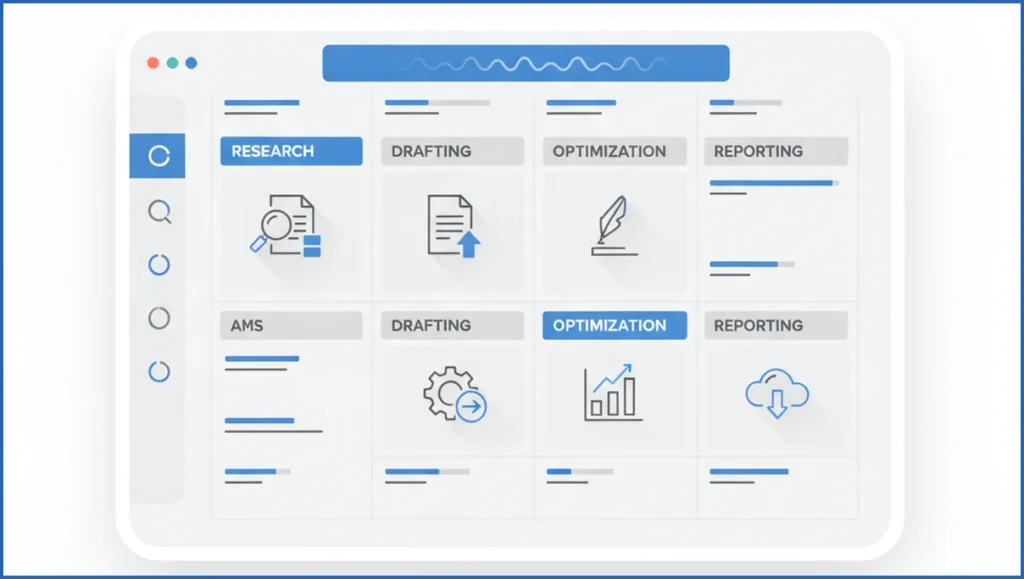
Most teams do not need more AI content. They need fewer manual handoffs. A strong ai agent seo workflow helps with research, clustering, drafting, QA, and reporting, while keeping humans on strategy and final judgment. The payoff is speed with structure, not random output. That distinction matters if you want better rankings, cleaner briefs, and fewer rewrites.
TL;DR
- Use AI agents to speed up repetitive SEO work.
- Keep humans in control of strategy and quality.
- Turn audits, briefs, and optimization into repeatable workflows.
- Measure impact with rankings, clicks, and content efficiency.
What an AI Agent SEO Workflow Actually Is
An AI agent SEO workflow is a chain of tasks where a model does work against a goal, checks rules, and passes output to the next step. That is different from a one-off prompt. It is also different from old-school automation, which usually follows fixed rules and breaks when the input changes.
For SEO, agents fit best where context shifts often. Think keyword clustering, SERP summary, content gap analysis, schema drafts, and internal link suggestions. If you are still deciding where agents fit inside a broader stack, this marketing agents overview gives the bigger picture.
A simple example helps. An agent can pull 500 queries, group them by intent, compare top pages, draft a brief, and flag missing entities. Then an editor reviews the brief before any copy gets written. That is a workflow. A prompt that says “write an SEO article” is not.
Pick the Right SEO Tasks for AI Agents
Start with high-volume, low-risk tasks. Good first picks are keyword clustering, title tag variants, meta descriptions, FAQ extraction, competitor summaries, and on-page audits. These jobs have clear inputs and visible outputs. They also create fast time savings.
Avoid handing agents your final claims, legal copy, or sitewide redirects without review. Those decisions carry business risk. Agents can suggest fixes, but humans should approve anything that affects accuracy, brand position, or crawl behavior. For hands-on ideas, this SEO automation software review is a useful benchmark.
One practical rule works well. Score each task on three axes: minutes saved, error cost, and data freshness. A 20-minute meta draft with low downside is a good fit. A hreflang rewrite across 4,000 URLs is not. Use agents where mistakes are cheap and review is quick.
Map a Repeatable Workflow From Brief to Publish
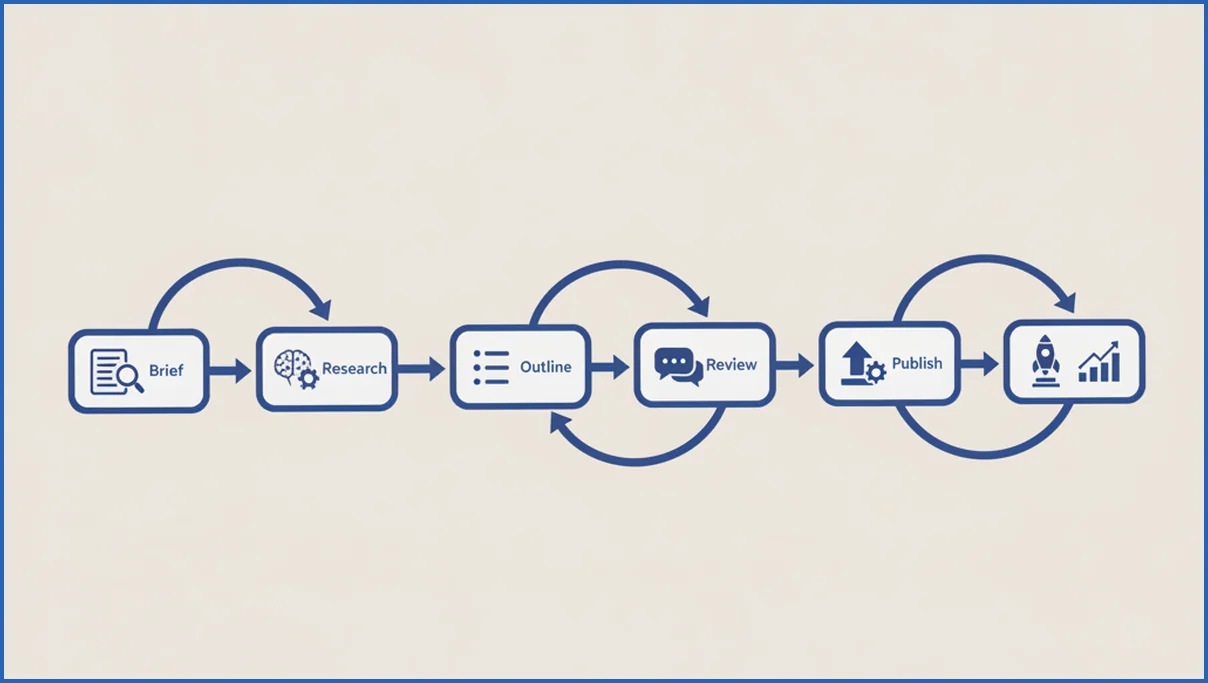
The cleanest setup is a staged pipeline. Each stage has one owner, one output, and one review gate. That keeps your team from treating AI like a black box.
- Pull source data from GSC, GA4, and your keyword tool.
- Cluster queries and summarize the live SERP.
- Create a brief with intent, headings, entities, and internal links.
- Draft the article, then run an SEO and fact-check pass.
- Send to human review, publish, and monitor for 14 to 28 days.
Here is a simple prompt pattern for the brief stage. It works better when paired with fresh performance data from the Google Search Console MCP endpoint.
Goal: create an SEO brief for one article.
Inputs: clustered keywords, top 10 SERP summary, target URL, internal link candidates.
Rules: cite source URLs, avoid claims without evidence, match brand tone, include FAQ ideas.
Output: primary intent, outline, entities, title options, meta description, link suggestions.
A real workflow might start with 47 queries ranking in positions 8-12. The agent groups them into three intents, drafts one consolidated brief, and suggests two existing pages to link. If you want a related editorial process, this content brief playbook maps the handoff well.
Build Guardrails for Accuracy, Brand Voice, and SEO Quality
Agents need constraints. Give them approved sources, banned phrases, reading level targets, link rules, and required sections. Ask for citations in drafts, even if you remove them later. That one rule catches a lot of made-up claims.
Brand voice also needs structure. Provide three sample paragraphs, a short style guide, and a list of preferred terms. If your team publishes comparison content, pair this with a realistic view of tool trade-offs so output stays honest instead of padded.
Quality gates should be boring and strict. Check search intent match, factual accuracy, uniqueness, internal links, metadata, and whether the piece actually answers the query. If an agent cannot pass those checks, it should not publish.
Connect Agents to Your SEO Stack
Agents get better when they can read real systems. Connect them to Search Console, GA4, your CMS, a keyword database, and your task tracker. That removes copy-paste work and keeps outputs tied to current data. MCP-based connections are useful here because they let the model access tools in a structured way.
A practical setup looks like this. GSC supplies queries and landing pages. GA4 adds engagement signals. The agent drafts a brief, pushes it into your docs or CMS, then opens a review task in Jira or Trello. Publishing still needs approval, but the admin work drops fast.

Measure ROI and Improve the System Over Time
Track two groups of metrics. First, measure workflow efficiency: hours saved per brief, drafts per editor, time from keyword to publish. Second, track SEO outcomes: impressions, clicks, rankings, CTR, and pages that move from positions 6-15 into the top 5.
Use a simple baseline. Compare 20 agent-assisted pages against 20 manually produced pages over 30 to 60 days. If output is faster but rankings stall, the bottleneck is probably brief quality or review depth. A disciplined GSC review process helps you spot those gaps quickly.
Good systems improve in loops. Save winning prompts, log failed outputs, and refine your checklists every month. Over time, the value comes less from the model itself and more from the process you built around it.
Frequently Asked Questions
What is an AI agent in SEO?
An AI agent in SEO is a model that completes a task with context, rules, and often access to tools or data. Instead of answering one prompt, it can move through steps like research, clustering, drafting, and QA. The useful part is not the model alone. It is the repeatable system around it, including approvals, source checks, and defined outputs.
Which SEO tasks should AI agents handle first?
Start with repetitive work that has low downside if the first draft is imperfect. Good candidates include keyword grouping, SERP summaries, title tags, meta descriptions, internal link suggestions, and content refresh audits. Leave strategy, final messaging, and high-risk technical changes with humans. Early wins come from tasks where review takes two minutes, not twenty.
How do I keep AI-generated SEO content accurate?
Require source-backed claims, approved references, and a fact-check step before publishing. Give the agent a short style guide, examples of good output, and explicit rules on what it cannot invent. Many teams also use a reviewer checklist for entities, links, dates, and product details. Accuracy improves when the model has less room to guess.
Can AI agents help with technical SEO?
Yes, but mostly as assistants rather than autonomous operators. They are useful for log summaries, crawl issue clustering, schema draft generation, redirect mapping suggestions, and ticket creation. They can also explain patterns from audits in plain language. Still, a human should approve anything that changes rendering, canonicals, indexing rules, or site architecture.
How do I measure success for AI SEO workflows?
Look at productivity and search performance together. Measure hours saved, content throughput, and revision cycles. Then compare impressions, clicks, CTR, and ranking movement for pages created with the workflow. A useful benchmark is the share of pages that improve within 30 to 60 days. Faster output alone is not success if quality drops.
Do AI agents replace SEO specialists?
No. They replace parts of repetitive production, not the judgment behind SEO decisions. Someone still needs to set priorities, choose target pages, spot weak SERP assumptions, and protect brand credibility. In practice, strong specialists often become more valuable because they can design better systems and review output faster than teams starting from scratch.
What tools are needed for an AI agent SEO workflow?
You need four parts: a model, data sources, a place to work, and a review path. That usually means an LLM, Search Console, analytics, a keyword source, docs or CMS access, and a task tracker. Optional additions include MCP connections, prompt templates, and QA scripts. The exact stack matters less than having clean inputs and clear approval steps.
If you build this workflow, start with one content type and one measurable bottleneck. For most teams, that means briefs first, not full article autopilot. You will learn faster from 10 clean runs than from one giant system that touches everything.