
Last updated: August 2026
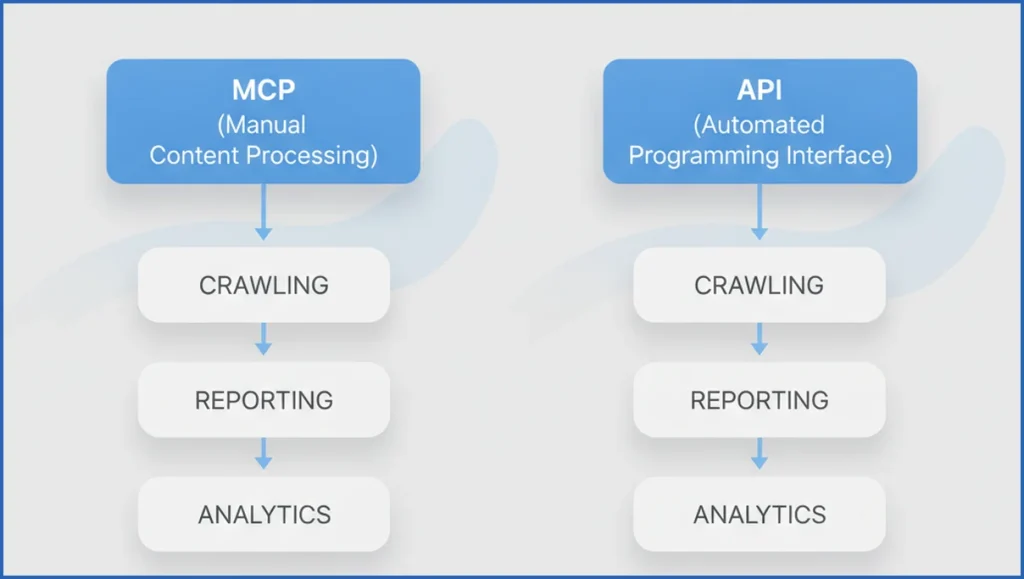
SEO teams keep hearing about MCP as if it replaces APIs. It does not. The useful framing is simpler. APIs are how tools expose data and actions. MCP is a standard that helps AI systems discover and use those tools with less custom wiring. If you build reporting, content, or analysis workflows, that difference matters because it changes orchestration more than the underlying data source.
TL;DR
- APIs expose data; MCP standardizes how models use tools.
- MCP can simplify multi-tool SEO workflows.
- APIs still win for direct, stable integrations.
- Choose based on control, speed, and your stack.
MCP vs API: the core difference in plain English
An API is a contract between software systems. You send a request to Google Search Console, Ahrefs, or your crawler, then get structured data back. You control the endpoint, auth, payload, retries, and rate limits. That model has powered SEO tooling for years.
MCP sits one layer higher. It gives an AI model a standard way to discover tools, understand inputs, and call them during a task. So the model can ask for query data, pull GA4 sessions, then draft an explanation without a developer hand-stitching every step. If you need the protocol details, this MCP server breakdown is the right mental model.
How each one fits SEO data workflows
For a rank drop investigation, an API-first flow is direct. Your script calls GSC, pulls the last 28 days, compares CTR and average position, then pushes a chart into Looker Studio. That works well when the task is fixed and predictable. Teams already doing repeatable GSC analysis workflows usually start here.
MCP helps when the workflow changes by prompt. Example: “Find pages with impressions above 5,000, CTR below 1.2%, then suggest title rewrites.” A model can call a Search Console tool, fetch page data, group patterns, and produce drafts in one session. That is why a Google Search Console MCP setup feels different from raw endpoints.
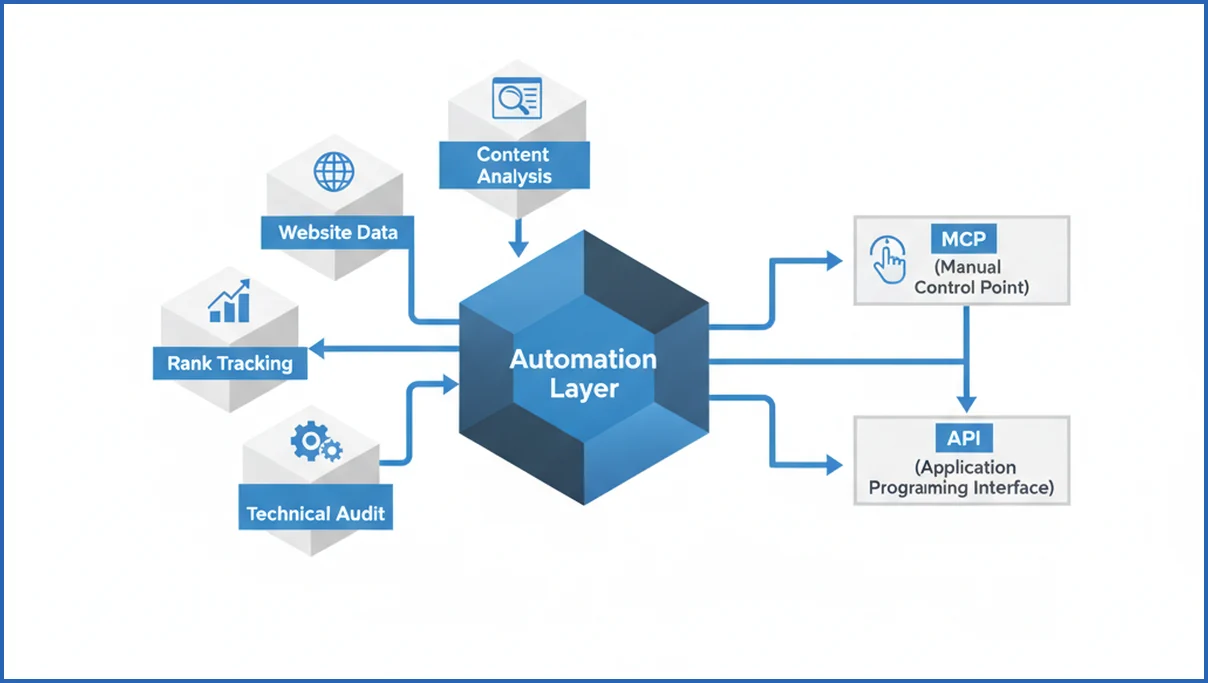
You can also mix both. Use APIs for crawling and warehousing, then expose selected actions through MCP for analysts and content teams. That split keeps your base data stable while giving AI a cleaner working surface.
When MCP is the better choice
MCP wins when a human or agent needs to move across several tools during one task. Think keyword clustering, intent review, SERP notes, internal link suggestions, and brief creation in one flow. That is the same shift behind agent-based marketing workflows.
It also helps with tool discovery. Instead of documenting 17 endpoints for every new analyst, you expose a smaller tool layer with clear schemas. A model can inspect available actions and choose the right one. For teams building prompt-driven operations, that reduces custom glue code and speeds up experiments.
When an API is still the better choice
APIs remain better for high-volume jobs, strict SLAs, and hard governance. If you need to sync 2.4 million rows from GSC into BigQuery every night, you want deterministic scripts, explicit retries, and clear logging. An MCP wrapper may add convenience, but it also adds another abstraction to debug.
They are also easier to benchmark. You can measure latency, error rate, and quota usage endpoint by endpoint. That matters when finance wants predictable costs or engineering owns maintenance. For durable pipelines, direct integrations often beat flexibility.
GET /search-console/query
{
  "siteUrl": "https://example.com",
  "startDate": "2026-07-01",
  "endDate": "2026-07-28",
  "dimensions": ["page","query"],
  "rowLimit": 25000
}
MCP vs API for SEO data: side-by-side comparison
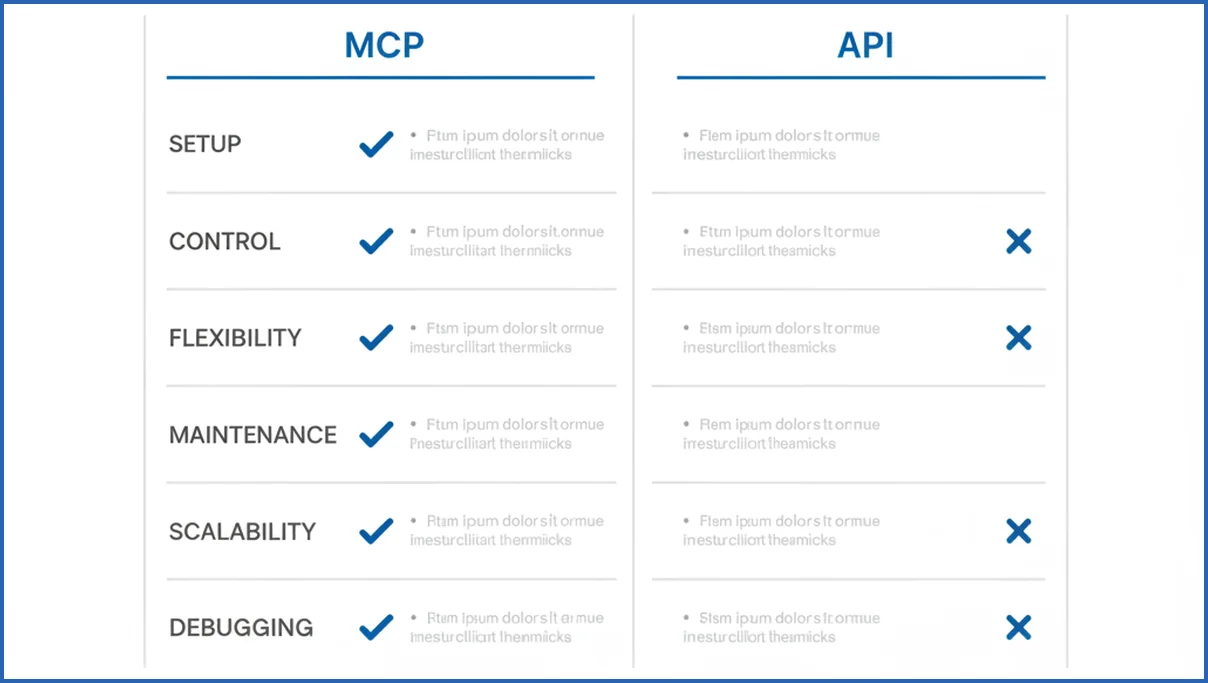
The tradeoff is not old versus new. It is orchestration versus control. MCP improves model-to-tool interaction. APIs give engineers tighter ownership of the pipeline.
| Feature | MCP | API | Verdict |
|---|---|---|---|
| Setup | Faster for model-driven tools | More manual wiring | MCP for experiments |
| Control | Indirect | Precise request handling | API wins |
| Flexibility | Strong across many tools | Strong per integration | MCP for mixed workflows |
| Maintenance | Simpler for non-dev teams | Cleaner for engineering-owned systems | Depends on team |
| Debugging | Harder across model decisions | Easier with logs and tests | API wins |
One honest tradeoff. APIs are better when you need reproducible batch outputs. MCP is better when the task itself changes often. If you are evaluating tools, this SEO automation software review is a useful companion.
How to choose the right approach for your team
Start with the bottleneck, not the protocol. If analysts lose hours moving between GSC, GA4, and content docs, MCP is usually the faster fix. If engineering already owns a warehouse and scheduled jobs, stick with APIs first.
- List your top 3 SEO workflows by hours lost per month.
- Mark each one as fixed process or prompt-driven task.
- Use APIs for fixed pipelines. Use MCP for variable, multi-tool work.
- Test one workflow for 14 days before expanding.
Many teams end up hybrid. That is sensible. A practical MCP layer for Claude on top of stable APIs often gives the best balance.
Frequently Asked Questions
Is MCP replacing APIs for SEO tools?
No. MCP usually depends on tools that still connect to APIs underneath. It changes how AI systems discover and call those tools, not the fact that data has to come from somewhere. For SEO platforms, APIs remain the core access layer for search, analytics, crawl, and reporting data.
Can MCP and APIs be used together?
Yes, and that is often the best design. Keep your direct API integrations for scheduled exports, warehousing, and reporting. Then expose selected actions through MCP for ad hoc analysis, content workflows, or agent tasks. That way, analysts get flexibility without forcing engineering to rebuild stable pipelines.
Which is easier to maintain for SEO automation?
For fixed jobs, APIs are usually easier to maintain because the logic is explicit and testable. For changing workflows run by marketers or strategists, MCP can be easier because you update tool definitions once instead of rebuilding every prompt-to-endpoint connection. The answer depends on who owns the system day to day.
Does MCP improve AI-generated SEO workflows?
It can, especially when the workflow spans several data sources and ends in a decision or draft. A model can pull query data, inspect traffic patterns, then write titles or outlines in one session. That makes MCP relevant to teams already working on structured AI writing workflows. Quality still depends on the tool design and the prompt.
What is the main advantage of an API over MCP?
Control. With an API, you decide exactly what gets called, how often, with which parameters, and what happens on failure. That makes APIs better for compliance, performance tuning, quotas, and large-scale sync jobs. When a workflow must be predictable every single run, direct endpoints are still the safer choice.
Should small SEO teams use MCP or API first?
Small teams should start with the option that removes the most manual work fastest. If nobody can maintain scripts, MCP may give quicker wins for analysis and briefing. If one person can handle lightweight automation, APIs can cover reporting and exports first. Choose the simplest path that solves one real workflow this month.
A good next step is to map one workflow, such as weekly GSC opportunity finding, and label each step as fixed or exploratory. That single exercise usually makes the MCP versus API decision much less abstract.