
Last updated: September 2026
ChatGPT Search vs Google: What Changes in Search is no longer a simple chatbot-versus-search-engine debate. Google now answers more like an assistant, while ChatGPT Search pulls closer to real-time web discovery. That overlap makes the choice feel blurrier, but the differences still matter. If you know which tool fits which task, you can research faster, compare answers better, and avoid trusting a polished summary when you really need source-level verification.
TL;DR
- Google still wins for breadth, speed, and live web coverage.
- ChatGPT Search is stronger for synthesis, context, and follow-up questions.
- Use Google to find, ChatGPT to understand and compare faster.
- The best workflow combines both tools for better decisions.
What ChatGPT Search and Google are built to do
Google is an index-first product. It crawls, ranks, and retrieves pages at web scale. Its job is discovery. That includes navigational intent, local results, shopping, news, and the long tail of pages you did not know existed. For SEO teams, that breadth still matters more than polished prose.
ChatGPT Search is answer-first. It tries to turn scattered sources into one readable response, then lets you ask follow-up questions in context. That makes it closer to an analyst than a directory. The trade-off is obvious. You get compression and reasoning, but you see less of the open web surface.
For marketers, this changes workflow design. Google remains the source map. ChatGPT becomes the interpreter. That is also why Google AI Mode and answer engine optimization now matter. Search is drifting from blue links toward resolved answers.
ChatGPT Search vs Google: speed, sources, and accuracy
Google usually wins on raw speed. It loads results, filters intent, and surfaces fresh pages in seconds. For breaking news, a newly published doc, or a product page updated this morning, Google is still the safer first stop. Its link graph and recency systems were built for that job.
ChatGPT Search often feels faster after the click. Ask for “best CRM for a 12-person SaaS with weak attribution and a $500 monthly budget,” and it can summarize trade-offs immediately. Good answers save ten tabs. Weak answers hide uncertainty behind smooth language, so source checking matters more.
A practical test is citations. Google shows many sources up front. ChatGPT Search may cite fewer sources, but it can explain them in plain English. Neither is automatically “more accurate.” Accuracy depends on query type, source quality, and how much freshness the question needs.
| Feature | ChatGPT Search | Verdict | |
|---|---|---|---|
| Freshness | Good, but uneven by query | Excellent for live web | |
| Synthesis | Strong | Limited without extra clicks | ChatGPT Search |
| Source breadth | Narrower visible set | Very broad | |
| Follow-up context | Excellent | Weak | ChatGPT Search |
Where ChatGPT Search is better than Google
ChatGPT Search is better when the task is messy. It handles comparison, summarization, and multi-step reasoning well. Ask it to compare three SEO crawlers for a site with 80,000 URLs, JavaScript rendering, and a two-person team. You will usually get a usable first draft faster than Google can provide one.
It also shines when you need translation between expert language and business decisions. A founder can ask, “Explain why our branded traffic grew while non-brand fell.” The answer can connect content gaps, query mix, and reporting caveats in one thread. That is hard to get from ten separate search results.
If you already work with AI-driven stacks, this feels similar to a disciplined AI workflow. The tool is most useful when you give constraints, not when you ask broad trivia questions.
Where Google still beats ChatGPT Search
Google still owns navigation. If you want a login page, a restaurant near Soho, a product in stock, or live coverage of an outage, Google is better. Its index is wider, its local layer is stronger, and its recency signals are far more visible.
Discovery also works better in Google. Search “technical SEO checklist” and you can scan dozens of perspectives fast. That matters when you want disagreement, not synthesis. AI answers often compress the web too early. Sometimes you need the messy source landscape before you trust a conclusion.

For SEOs, Google remains the main measurement environment too. You still validate demand, impressions, and CTR in Search Console, not in a chatbot. That is why teams building AI-assisted reporting keep one foot in the Google Search Console MCP layer and one foot in conversational analysis.
How to use both tools together in one workflow
The best workflow is simple. Use Google for collection. Use ChatGPT Search for compression. Then verify the answer against primary sources and your own data.
- Search Google for the topic, plus modifiers like “2025”, “pricing”, “case study”, or “docs”. Open 5 to 8 strong sources.
- Ask ChatGPT Search to compare those sources, extract disagreements, and state what is still uncertain.
- Check claims against your own numbers in GSC or GA4.
Here is a real SEO example. Say a page ranks for 47 queries in positions 8 to 12. Pull those terms, cluster them, and ask ChatGPT Search which intent patterns are missing from the current page. Then confirm the opportunity with a GSC analysis workflow or your analytics layer.
Task: Compare the top 6 ranking pages for "chatgpt search vs google"
Return:
1. Common subtopics
2. Missing angles
3. Source disagreements
4. Claims that need verification
5. Suggested outline for an SEO article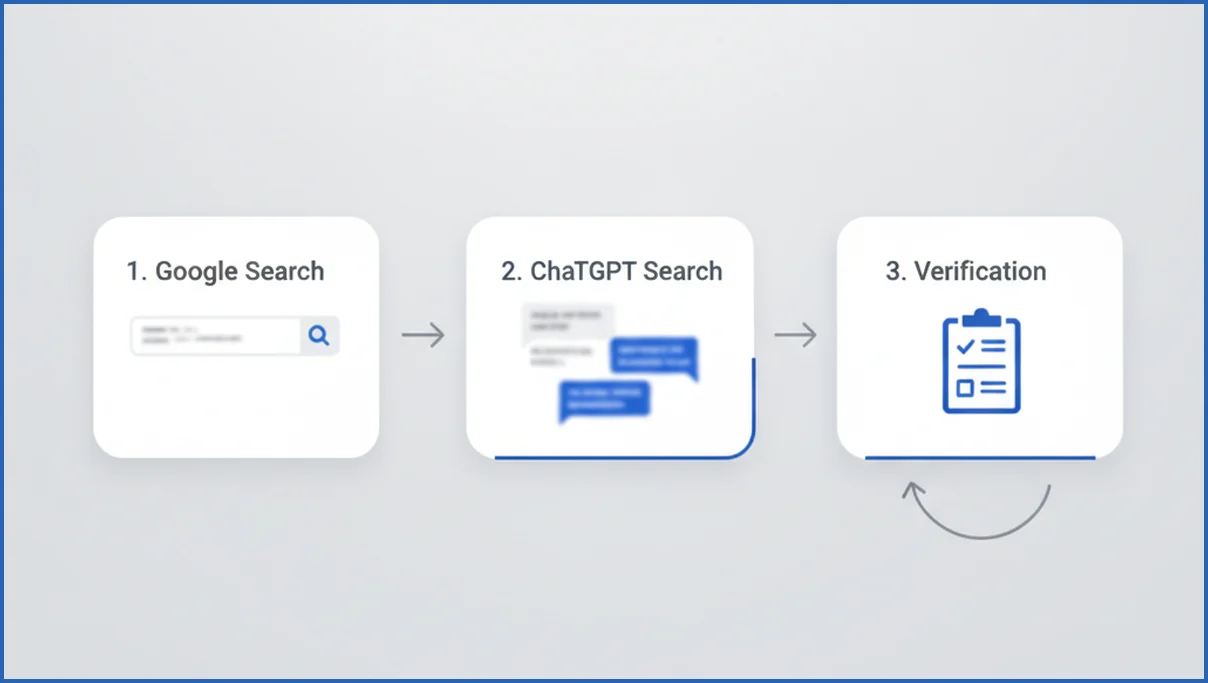
If you want this connected directly to data tools, MCP-based search and analytics setups are the practical next step. They reduce copy-paste and force better verification habits.
What the rise of AI search means for SEO and users
AI search changes expectations first. Users now expect direct answers, source summaries, and follow-up help in one place. That means content has to do more than rank. It has to resolve questions clearly enough that an AI system can quote, summarize, or trust it.
For SEO, the shift is not “Google is dead.” It is distribution fragmentation. Some clicks go to classic search. Some go to AI Overviews. Some vanish because the answer gets resolved on-platform. That is why generative engine optimization and standard SEO now sit on the same roadmap.
Writers and site owners should care about format. Clean structure, explicit claims, useful comparisons, and first-hand evidence travel better across both systems. Thin pages built only to capture a click were already weak. AI search just exposes that weakness faster.
ChatGPT Search vs Google AI Overviews
Google AI Overviews and ChatGPT Search can look similar at first glance, but they serve different search moments. AI Overviews sit on top of classic Google results and try to answer a query fast. They are built for speed inside a familiar search page. ChatGPT Search feels more like a research assistant. It invites follow-up prompts, reformulation, and deeper explanation without forcing you back into a standard results layout.
That distinction matters in practice. If you search “best running shoes for flat feet,” Google AI Overviews may surface a quick summary plus retailer and review links. If you ask ChatGPT Search the same question, it will often organize tradeoffs, explain stability versus cushioning, and help you refine for budget, mileage, or injury history. One tool compresses discovery. The other supports guided thinking.
For publishers and SEOs, AI Overviews also sit closer to ranking systems, snippets, and citation patterns already tied to Google visibility. ChatGPT Search may cite sources too, but user behavior can stay inside the conversation longer. That means your content needs strong factual structure, scannable comparisons, and answer-first formatting in both environments. The playbook overlaps with AI search optimization, but each surface rewards slightly different user expectations.
How Google AI Mode changes the ChatGPT Search comparison
Google AI Mode makes this comparison less about blue links versus chat. Now both tools try to answer, summarize, and guide follow-up questions. The real split is context. Google AI Mode stays closer to Google’s live search ecosystem, local intent, shopping data, and maps-style tasks. ChatGPT Search still feels stronger when you want a cleaner back-and-forth, a rewritten explanation, or help narrowing a messy question.
That changes how people evaluate search quality. Instead of asking which tool finds more pages, users often judge which tool reduces effort. Google AI Mode can shorten the path for product comparisons, quick how-to queries, and exploratory searches. ChatGPT Search can still win when the task needs synthesis across sources, tone adjustment, or a more conversational workflow. If you need a deeper breakdown of features and rollout, see Google AI Mode explained.
- Google AI Mode narrows the gap on summarized answers and guided follow-up search.
- ChatGPT Search still stands out for conversational refinement and easier reframing of complex questions.
- For many users, the better choice depends on task type, not brand loyalty.
Frequently Asked Questions
Is ChatGPT Search better than Google for research?
It is better for parts of research, not all of it. Use ChatGPT Search when you need a quick synthesis, a comparison, or help framing follow-up questions. Use Google when you need source breadth, recent documents, or independent perspectives. Serious research usually needs both. One helps you scan. The other helps you think.
Does ChatGPT Search use Google results?
Do not assume that it does in the same way a browser search does. ChatGPT Search can reference web sources, but its retrieval and answer format are not the same as Google’s ranking system. That matters because the visible source set may differ. If source coverage is critical, run the same query in both tools and compare what appears.
Which is more accurate: ChatGPT Search or Google?
Neither wins every time. Google is often more dependable for fresh, navigational, and local queries because it surfaces many direct sources fast. ChatGPT Search can be more useful for synthesis, but a fluent answer can still miss nuance. Accuracy improves when you inspect the cited pages, check dates, and test claims against primary documents.
Can ChatGPT Search replace Google for everyday use?
For some tasks, yes. It can replace a chunk of comparison searches, definition lookups, and summary work. It does not fully replace Google for maps, shopping, recent news, login finding, or broad exploration. Most people will settle into a split habit. They will ask AI for interpretation and use Google when they need direct access to the web.
Why do ChatGPT Search answers sometimes differ from Google?
The tools optimize for different outputs. Google ranks pages. ChatGPT Search builds an answer from a smaller visible set of sources plus model reasoning. Different source selection, different timing, and different handling of ambiguity can produce different outcomes. That does not always mean one is wrong. It often means the question needs tighter scope or fresher validation.
What is the best way to fact-check AI search results?
Start with the citations inside the answer, then open the original pages and confirm the exact claim. Check publication dates, author credibility, and whether the AI merged separate facts into one statement. For SEO or traffic topics, verify against your own Search Console and analytics data. Fact-checking gets easier when your workflow includes primary sources from the start.
Use Google for the first pass on any query with time sensitivity or broad discovery needs. Use ChatGPT Search after that, when the job shifts from finding pages to making a decision.
Will Google AI Mode make ChatGPT Search less useful?
Not necessarily. Google AI Mode makes Google better at conversational search, but ChatGPT Search still helps with synthesis, rewrites, and iterative questioning. Many users will switch between them based on task. Google may win for local, shopping, or fresh web discovery. ChatGPT Search can still be more useful for understanding a topic, comparing viewpoints, or reshaping a rough question into something clearer.
What this means for search users and marketers
Google AI Mode does not erase the ChatGPT Search use case. It raises the standard for both tools and pushes search toward guided answers instead of simple link lists. Users should expect to compare outputs, not just rankings. Marketers should build pages that answer clearly, show evidence, and support follow-up intent. For a broader planning lens, see our SEO strategy in 2026.