
Last updated: July 2026
AI search systems do not just parse keywords. They look for signs that a page deserves to be quoted, summarized, or cited. That puts eeat seo in the middle of modern visibility work. If your page makes claims without evidence, hides authorship, or looks stale, AI answers may skip it even when the topic fit is good.
TL;DR
- E-E-A-T now influences how AI search systems judge trust.
- Proof beats claims: show expertise, experience, and sources.
- Strong site signals support better visibility in summaries and answers.
- Use a repeatable checklist to audit and improve pages fast.
What E-E-A-T Means in AI Search
E-E-A-T stands for experience, expertise, authoritativeness, and trustworthiness. Google frames it in its Search Quality Evaluator Guidelines, but the idea matters beyond classic ranking. AI systems need reliable source material to form answers. They prefer pages that state who wrote them, why that person knows the topic, and what evidence supports each claim.
Experience matters more than many teams admit. A page that says, “we tested 12 title tag variants across 430 URLs,” carries more weight than generic advice. This is also why answer engine optimization and eeat seo overlap. Both reward pages that are easy to cite, verify, and trust.
Why E-E-A-T SEO Matters More Now
AI-generated answers compress many sources into one response. That raises the bar. If your content looks thin, uncredited, or copied from consensus posts, it has less chance of shaping the final answer. You may still rank, but fail to earn mention.
Trust signals also help on YMYL topics like health, finance, and legal advice. Yet the same pattern shows up in SaaS, B2B, and ecommerce. Search systems want fewer unsupported claims. For teams adapting to AI summaries, Google AI Mode changes make that shift hard to ignore.
The Core Trust Signals AI Search Can Read
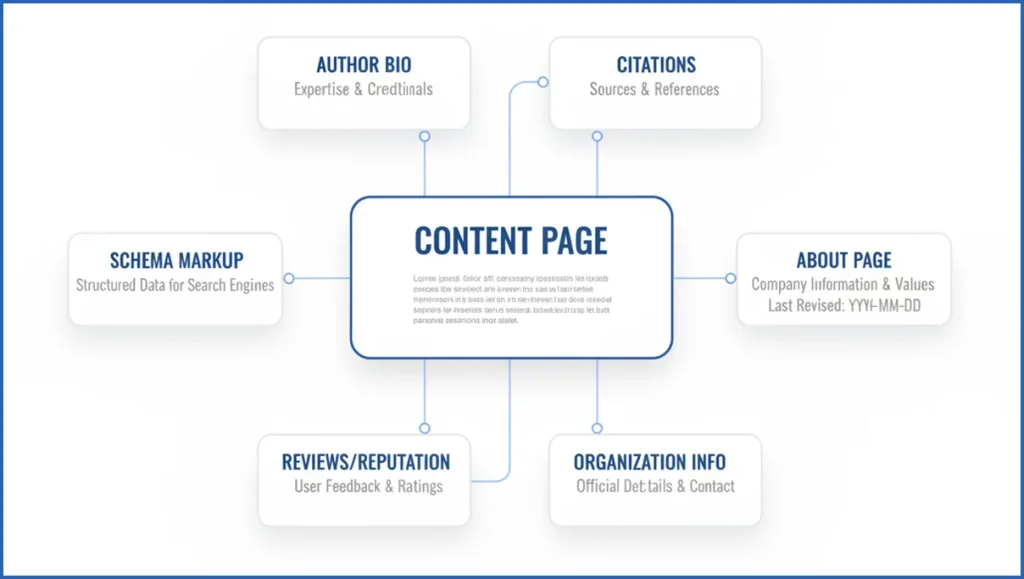
Start with authorship. Every important page should show a real author, short bio, role, and topical credentials. Add an editor when review matters. Next, cite primary or close-to-primary sources, not just roundup blogs. A publication date and clear update date help machines and humans judge freshness.
Sitewide trust matters too. Your about page, contact details, editorial policy, company information, and off-site reputation all support the page-level story. Structured data helps connect entities, but schema alone will not rescue weak content. If you want a stronger operating model, MCP workflows for SEO teams can speed audits across these signals.
How to Audit Your Content for E-E-A-T Gaps
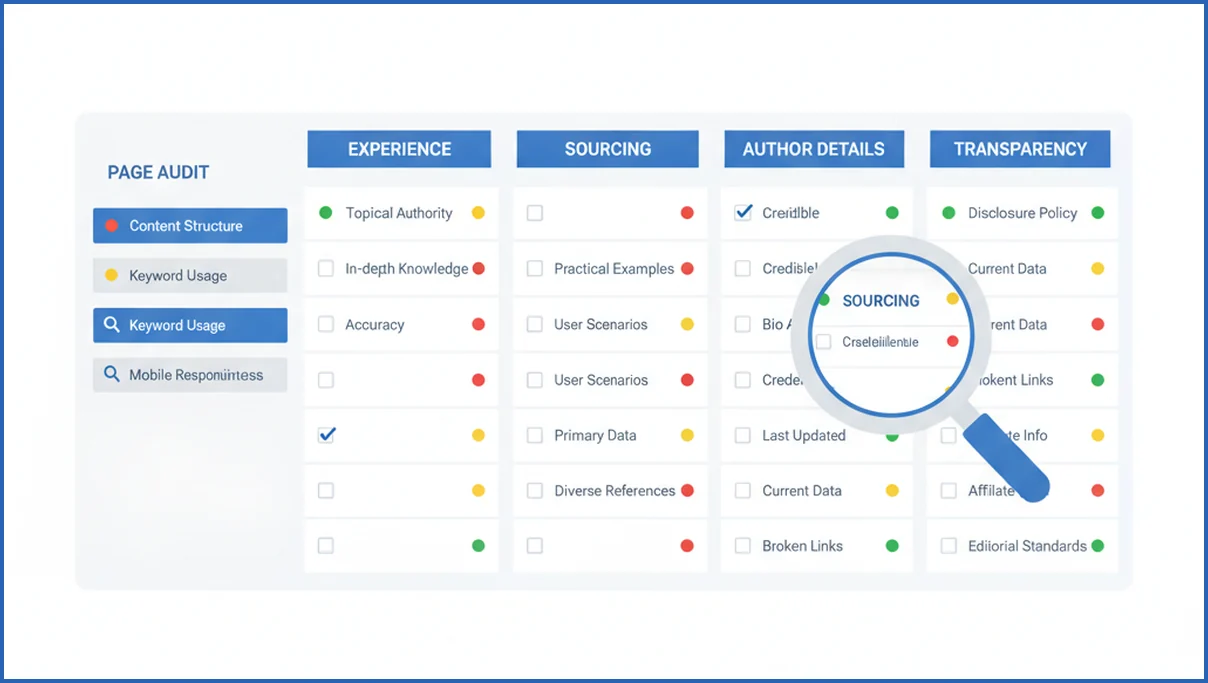
Pick 20 URLs that matter. Score each page across six checks: firsthand experience, author clarity, source quality, factual freshness, transparency, and reputation support. Use a simple 0-2 scale. A page scoring 5 out of 12 usually has obvious problems.
Then inspect claims line by line. Flag statistics with no source, product advice with no testing notes, and sections older than 12 months. In practice, a GSC review often reveals pages ranking in positions 6-12 that need trust upgrades, not new keywords. A GSC analysis workflow helps surface those candidates fast.
- Export top non-brand pages from Search Console.
- Mark pages with declining clicks or impressions.
- Review author, sources, dates, and proof.
- Rewrite unsupported claims or add evidence.
- Republish with clear update notes.
A Practical E-E-A-T Optimization Workflow
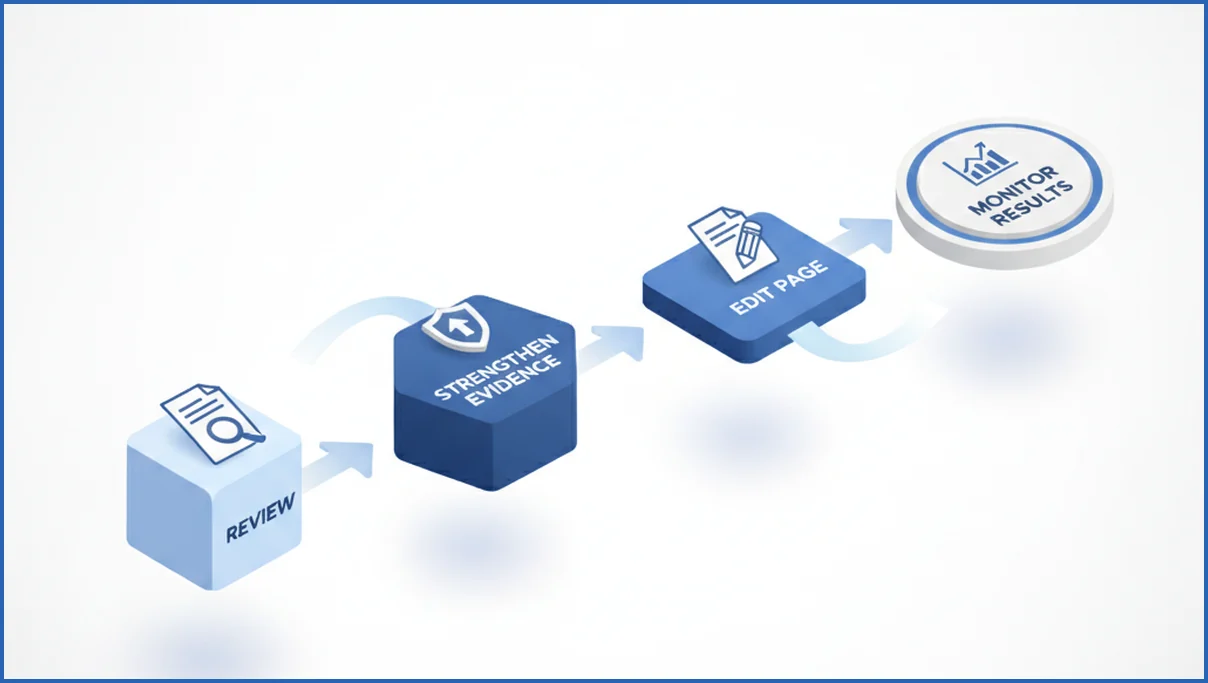
Use a repeatable system. First, add proof of experience. That can be screenshots, test setup notes, pricing comparisons, or implementation details. Second, tighten citations. Replace vague references with named studies, documentation, or first-party data. Third, improve author pages and connect them to relevant topics.
Here is a lightweight prompt-to-audit flow using the Google Search Console MCP and a manual review pass:
1. Pull pages with falling clicks over 90 days.
2. Filter to queries in positions 4-12.
3. Review each URL for missing author, date, sources, and firsthand proof.
4. Add evidence and update title or intro only if needed.
5. Recheck impressions, CTR, and assisted conversions after 21 days.
A real example: a B2B software page added named author credentials, three product screenshots, a pricing table date stamp, and two primary citations. CTR rose from 2.8% to 4.1% over 28 days. The content topic did not change. Trust presentation did.
Common Mistakes That Hurt E-E-A-T
Many teams publish expert-sounding content with no visible expert attached. That is the cleanest way to look generic. Another common miss is overclaiming. If you say a tool is “most accurate,” show the test or drop the line.
Poor editorial hygiene also hurts. Broken citations, no update dates, fake review language, and stock bios erode trust fast. So does publishing dozens of shallow AI drafts. If your process still centers on volume, a better AI writing workflow is a safer fix than another content sprint.
Measure Whether Your E-E-A-T SEO Is Working
Track more than rankings. Watch citation frequency in AI answers, branded search growth, assisted conversions, and engagement on updated pages. In Search Console, compare impression and CTR changes for refreshed URLs over 21, 45, and 90 days.
Also separate trust fixes from topic expansion. If a page gets better CTR but flat impressions, your credibility signals improved the snippet or answer appeal. If impressions rise too, relevance and trust likely moved together. That is a useful distinction for planning your broader SEO strategy.
Frequently Asked Questions
What is the difference between E-E-A-T and SEO?
SEO covers discovery, relevance, indexing, and performance. E-E-A-T is a trust lens inside that larger system. It asks whether the page deserves belief, especially when advice could affect money, health, safety, or buying decisions. A page can be technically well optimized and still weak on E-E-A-T if it lacks clear authorship, evidence, or credible sourcing.
Does E-E-A-T directly affect rankings in AI search?
Not as a single visible ranking metric. Google has said E-E-A-T itself is not one score, but the underlying signals clearly matter. In AI search, those signals affect whether your content is good source material for summaries, citations, and answer synthesis. Treat it as a practical influence on inclusion and confidence, not a standalone number.
How do I prove experience on a content page?
Show what you actually did. Add screenshots, setup details, test criteria, results, mistakes, and limitations. If you reviewed software, mention account tier, date tested, and workflows used. If you advise on SEO, include examples like “we updated 17 category pages and measured CTR after 30 days.” Specifics beat polished claims every time.
Which author signals matter most for trust?
Real name, relevant role, topical background, and a linked author page matter most. A useful bio explains why this person can speak on the topic now, not just where they worked ten years ago. External proof helps too, such as talks, publications, or product ownership. Match the signal strength to the risk level of the topic.
Can small websites compete on E-E-A-T?
Yes, especially in narrow topics where firsthand experience matters more than raw brand size. A smaller site can win with sharper testing, clearer sourcing, and more honest authorship. Big brands still have reputation advantages, but they also publish generic pages. Depth, transparency, and freshness let smaller teams punch above their size in many niches.
How often should I update E-E-A-T content?
Use topic volatility, not a fixed calendar, as the main rule. Software, finance, and AI topics may need reviews every 30 to 90 days. Evergreen educational pages can go longer if claims remain current. At minimum, check any page with declining clicks, outdated screenshots, changed pricing, or broken citations. Update notes should reflect real changes, not cosmetic edits.
What content types benefit most from E-E-A-T?
Product comparisons, medical advice, financial guidance, legal explainers, and technical tutorials benefit the most. Those formats ask readers to trust claims, methods, and recommendations. Buyer guides and implementation content also gain from visible proof. When a page can influence action, cost, or risk, stronger E-E-A-T usually improves both search visibility and conversion confidence.
Pick five high-value pages this week and score them for evidence, authorship, sourcing, freshness, and transparency. You will probably find that the ranking problem is not only relevance. Often, it is missing proof.