
Last updated: August 2026
SEO for SaaS Startups: A Practical Playbook for Growth now means earning visibility across classic rankings, AI answers, and buyer-led comparisons. The startups that win do not publish content for volume alone. They build product and editorial pages that reduce uncertainty, show proof fast, and move visitors toward demos or trials. In 2026, strong SaaS SEO is less about traffic totals and more about being the clearest, most citable option when search systems summarize the market.
TL;DR
- SEO for SaaS works best when tied to pipeline, not vanity traffic.
- Start with search intent, product pages, and conversion-focused content.
- Technical SEO and internal linking make every content effort work harder.
- A clear measurement loop helps you scale what drives demos and signups.
What SEO for SaaS Really Means in 2026
SaaS buyers do not move in a straight line. They search a pain point, scan alternatives, read reviews, then revisit your site weeks later. Good SaaS SEO supports that whole path. It should improve discovery, product understanding, trial starts, and even retention through help content and use-case pages.
Generic SEO often chases volume. SaaS SEO should chase qualified intent. A page ranking for “customer onboarding software” with 500 visits can beat a 10,000-visit informational post if it drives 14 demos a month. That is why teams now blend classic SEO with answer engine optimization and sharper commercial page strategy.
Search visibility also has to match product complexity. If your tool serves RevOps, support, and finance, one homepage will not carry the load. You need segmented pages, proof, and clean internal paths. If your broader plan needs a reset, this practical SEO strategy framework is a useful benchmark.
Build the Foundation: Technical, Tracking, and Site Structure
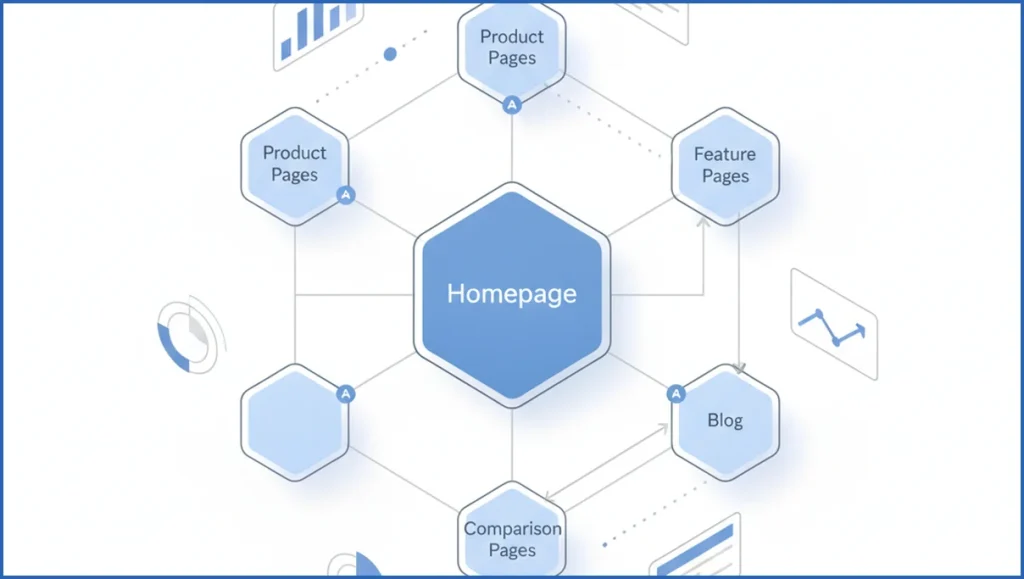
Before you publish 40 articles, make sure Google can crawl, understand, and measure your site. That means indexable product and feature pages, consistent canonicals, fast templates, and a simple architecture. Most SaaS sites work well with five core folders: product, features, solutions, comparisons, and blog.
Tracking comes next. Connect Search Console and GA4, define trial or demo events, and map them to page types. A founder should be able to answer one question fast: which landing pages influenced pipeline last month? If your team wants a faster reporting setup, the Google Search Console MCP and GA4 MCP tools remove a lot of manual exports.
A practical structure looks like this: homepage links to product pages, each product page links to two to four feature pages, and every blog post points to a relevant commercial page. That structure spreads authority and keeps buyer intent visible. Search Console analysis workflows help spot pages sitting in positions 6 to 12, where small internal link improvements can move revenue.
Map Keywords to the SaaS Funnel
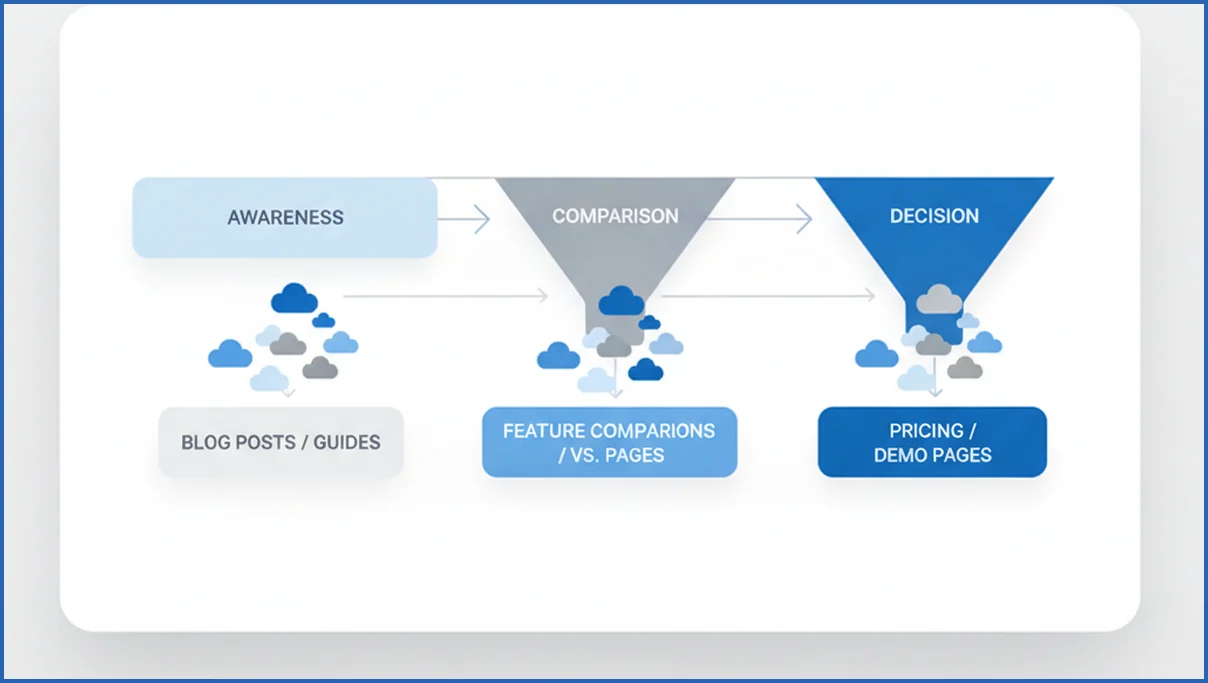
Keyword research for SaaS works better when you group by buying stage, not just topic. Top-of-funnel terms explain a problem. Mid-funnel terms compare methods or categories. Bottom-funnel terms name software, alternatives, pricing, integrations, or jobs-to-be-done. Each group deserves a distinct page type.
For example, a customer support platform might map “reduce ticket backlog” to an educational guide, “help desk vs shared inbox” to a comparison page, and “best help desk software for SaaS” to a category page. One feature page could target “AI ticket routing software” plus a small cluster of close variants. The workflow in this keyword clustering playbook fits that process well.
Use a simple rule. One primary intent per page. If a keyword set mixes education and purchase behavior, split it. That keeps copy clear and improves conversion paths. It also makes briefs easier if you use a structured content brief workflow for production.
Create Pages That Convert Searchers into Leads
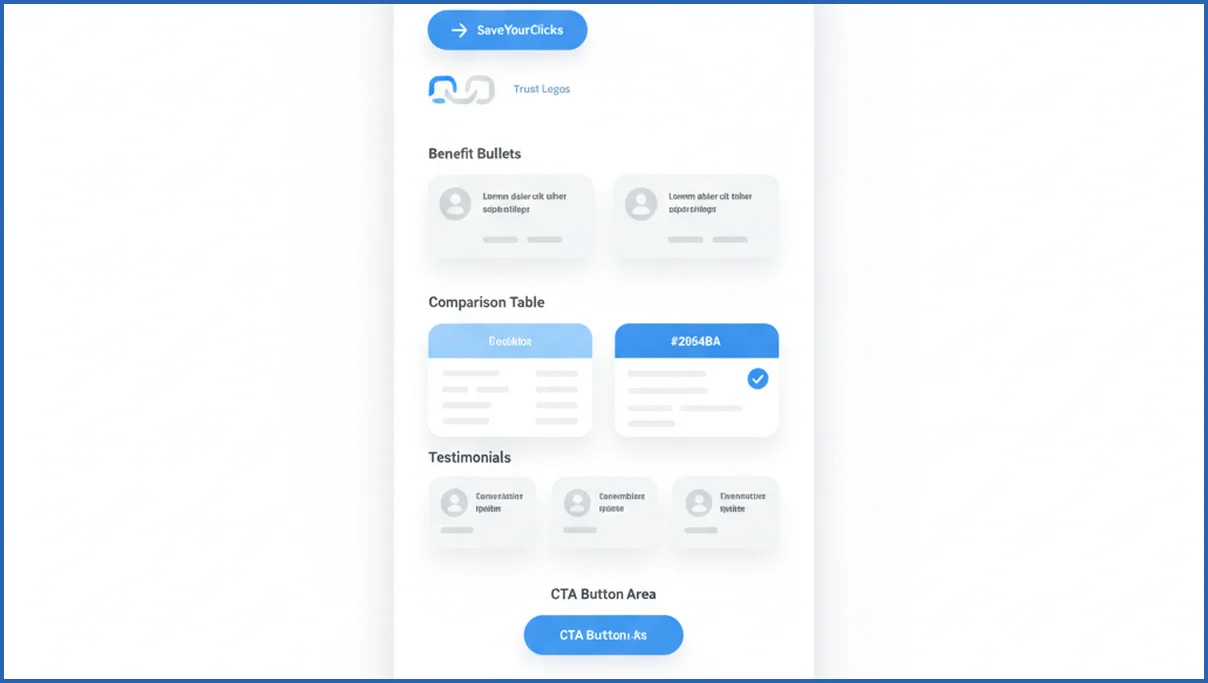
Many SaaS sites rank pages that do not sell. A good product or feature page answers four things fast: what it does, who it is for, why it is better, and what happens next. Keep the hero clear, show product UI, add proof, and handle common objections before the CTA.
A comparison page is a strong example. If you sell project management software, a “Your Brand vs Asana” page can rank, pre-handle switching concerns, and collect high-intent leads. Include feature differences, onboarding time, pricing context, and ideal-fit guidance. Honest trade-offs matter. If a rival has stronger marketplace integrations, say so.
For on-page execution, use descriptive titles, tight H2s, schema where relevant, and internal links back to core solution pages. Teams refining this layer often borrow ideas from on-page SEO workflows with AI to speed testing without flattening the copy.
Publish Content That Builds Trust and Demand
Blog content still matters, but only when it supports the buying journey. Publish educational posts for pain-point discovery, templates for email capture, case studies for proof, and BOFU assets for evaluation. A healthy mix often looks like 50 percent commercial support content, 30 percent educational posts, and 20 percent proof assets.
An early-stage startup could publish one product-led template, one use-case article, and one comparison page each month. That beats eight generic AI-written posts with no buyer path. If you need a planning model, this 2026 content strategy guide maps content to business goals more clearly than a raw editorial calendar.
- Pick one funnel stage that is under-supported.
- Choose a keyword cluster with clear commercial relevance.
- Assign the right page type, not just a blog post.
- Add one strong internal link path to demo or trial pages.
- Review assisted conversions after 30 to 45 days.
Measure SEO Success and Decide What to Scale
Traffic is a weak summary metric for SaaS. Better metrics are qualified organic sessions, trial starts, demo requests, assisted conversions, and pipeline influenced by landing page group. Track these by page type so you can see whether comparisons, features, or blog posts actually move revenue.
Review underperformers in three buckets: pages with impressions but low CTR, pages with clicks but weak conversion, and pages stuck outside the top five. Each bucket has a different fix. Titles and snippets help CTR. Offer clarity and proof help conversion. Internal links and intent alignment help rankings. If your team wants a cleaner ops layer, MCP-based reporting workflows can speed diagnosis.
Page type | Metric | Good signal
Feature page | Trial conversion rate | Above site average
Comparison page | Demo assists | Growing month over month
Blog post | Assisted signups | At least 1-3 per quarter
How to optimize SaaS pages for AI Overviews and zero-click searches
AI Overviews reward pages that resolve a question quickly, then support deeper evaluation. For SaaS startups, that usually means product pages, use-case pages, and comparison pages deserve as much attention as blog posts. Open with a one-sentence answer, then add short sections for who the feature fits, what problem it solves, how it works, and what constraints matter. This structure helps humans scan and gives search systems extractable passages.
Specificity matters more than polish. Replace vague copy like “streamline workflows” with product facts such as “sync HubSpot contacts in under five minutes” or “export board-level KPI reports as CSV and PDF.” Include pricing context, implementation requirements, security notes, and support availability where relevant. If your page targets “best CRM for small sales teams,” add a compact comparison table, ideal-fit summary, and a balanced note on tradeoffs. These details improve usefulness for both classic results and answer surfaces.
Formatting also affects whether your page becomes citation material. Use descriptive subheads, concise paragraphs, bullet lists, tables, schema where appropriate, and consistent terminology across product and help content. Add first-party proof like screenshots, customer quotes, and links to documentation. If you are building an editorial system around this, answer engine optimization offers a helpful lens for designing pages that win even when clicks are reduced.
How AI Mode changes SEO for SaaS startups
Google AI Mode changes what a successful SaaS page must do. Ranking is still useful, but visibility now often starts inside synthesized answers, follow-up prompts, and comparison summaries. Google has framed AI-powered search as a more conversational experience, with deeper query refinement and multimodal exploration (Google I/O 2024 and Google blog updates). For SaaS startups, that means pages must answer jobs-to-be-done clearly, prove claims fast, and support product evaluation without relying on a click alone.
The practical shift is simple. Write pages that help both the model and the buyer. Product, feature, integration, alternative, and pricing pages should surface exact use cases, setup details, limitations, and proof points. Add original screenshots, customer language, and concrete outcomes like reduced reporting time or faster onboarding. Teams that need a broader framework can pair this with Google AI Mode explained to understand how discovery paths are changing.
- Lead with direct answers to common SaaS buying questions.
- Support every core claim with visible product evidence and specifics.
- Build page depth for follow-up questions, not just one keyword.
Frequently Asked Questions
Is SEO dead or evolving in 2026?
It is evolving, not dying. Search now includes AI Overviews, answer engines, and more zero-click behavior, but buyers still need sources, comparisons, and product pages. SaaS companies that publish original proof, clear positioning, and decision-stage pages still win. The weak pattern is generic content with no product tie-in.
How long does SEO for SaaS startups take to work?
Most startups see early movement in 8 to 12 weeks if the site is crawlable and pages target realistic terms. Commercial results usually take longer, often 3 to 6 months, because buyers compare options before converting. Faster wins often come from comparison pages, feature pages, and updates to existing content.
Should SaaS startups focus on blog posts or product pages first?
Start with product, feature, use-case, and comparison pages. Those pages match buying intent and convert better. Blog posts should support them, not replace them. If your site has little authority, educational content can help discovery, but it should still connect directly to a commercial path and a defined audience problem.
What metrics matter most for SaaS SEO?
Track qualified organic users, branded versus non-branded clicks, trial starts, demo requests, assisted conversions, and influenced pipeline. Also watch rankings by page type, not just by keyword. A blog post in position two matters less than a comparison page in position five if the second one drives pipeline.
How many keywords should a SaaS page target?
Target one primary intent and a small cluster of close variants. For most SaaS pages, that means one main keyword plus 3 to 10 semantically related terms. Do not mix very different intents on one page. A feature page and a broad educational guide usually need separate assets to perform well.
Can a new SaaS company rank without backlinks?
Yes, for low-competition and specific intent terms. New sites often rank first for long-tail use-case keywords, integration queries, and narrowly framed comparison pages. Still, links help. The smarter move is to publish link-worthy assets such as original data, templates, and strong product-led guides while your commercial pages mature.
Start by auditing your existing commercial pages before writing another blog post. Most SaaS startups already have enough demand signals. They just hide them behind weak structure, unclear positioning, or missing conversion paths.
How should SaaS startups optimize for AI Overviews in 2026?
Focus on pages that answer buying questions clearly and prove claims quickly. Use concise summaries, comparison tables, screenshots, FAQs, and concrete product details such as pricing, setup time, integrations, and limits. Prioritize product, feature, and alternative pages before adding more top-funnel content. For teams planning around broader AI search shifts, AI search optimization is a useful companion framework.
Next steps for SaaS search growth
SaaS SEO still compounds, but the playbook is sharper now. Build pages that answer clearly, compare honestly, and prove product value with evidence. Treat AI Mode, AI Overviews, and zero-click discovery as part of the same system, not separate channels. When every important page helps a buyer make a decision, search visibility becomes more resilient and much closer to revenue.