
Last updated: July 2026
AI Blog Writing Workflow: A Practical Playbook for Better Posts starts with a simple shift. Stop asking AI to write publish-ready articles. Ask it to help with repeatable tasks inside a clear editorial system. That means defined prompts, source checks, brand rules, and review steps. Teams that do this well ship faster without filling their blogs with generic copy. If your process still relies on one big prompt, this is where a stronger AI copywriting workflow can improve quality.
TL;DR
- Use AI for research, outlining, drafting, and polishing.
- Keep human input in strategy, facts, and final voice.
- A clear workflow beats random prompting every time.
- Choose the right tools based on your blog goals.
What AI Blog Writing Can and Can’t Do
AI is strong at pattern work. It can summarize ten SERP pages, suggest headings, and turn notes into a readable first draft in minutes. That makes it useful for content teams with tight calendars, or founders publishing without a full editorial staff.
It is weak at deciding what matters most. AI often states the obvious, flattens your point of view, and invents specifics when the prompt is vague. That is why strong AI copywriting workflows put a human on topic selection, source review, and final edit.
For SEO, AI helps most when paired with live performance data. If a page already ranks for 47 queries in positions 8 to 15, AI can help reshape the draft around those terms. The input still needs to come from tools like the Google Search Console MCP, not from the model’s memory.
Build a Repeatable AI Blogging Workflow
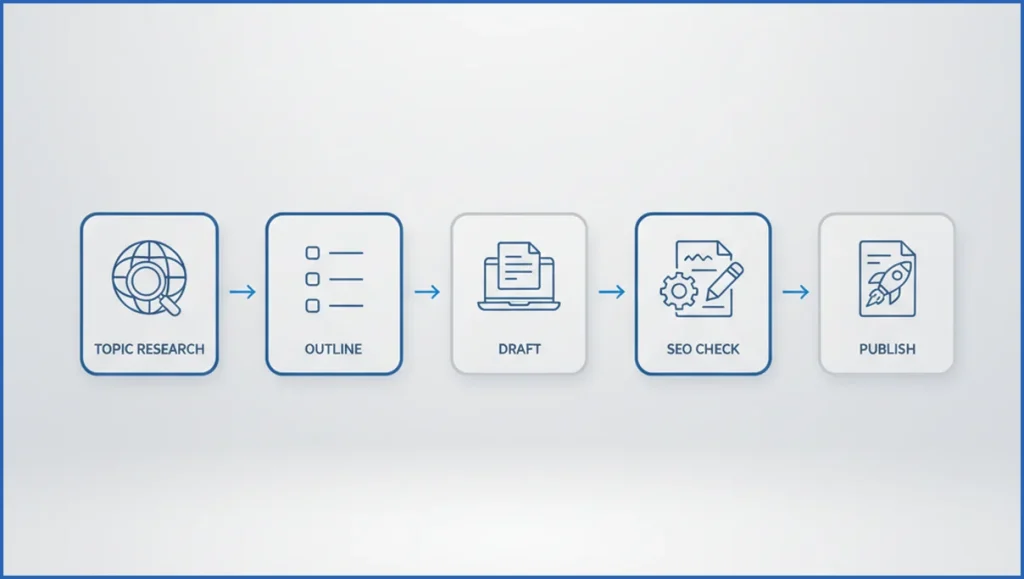
A repeatable workflow keeps quality stable across posts. Start with a keyword, confirm business fit, inspect the SERP, build an outline, draft section by section, then run a hard edit for facts and on-page SEO. That order matters because AI writes better when the brief is specific.
One simple process works well for small teams. Use it every time, then improve the weak step instead of blaming the model.
- Pick a topic with search demand and conversion relevance.
- Collect SERP patterns, related questions, and existing site data.
- Write a brief with audience, angle, sources, and sections.
- Generate a draft in blocks, not one giant prompt.
- Edit for claims, links, headings, and readability.
- Publish, then measure impressions, clicks, and assisted conversions.
If you manage several channels, this should connect with the wider content marketing strategy, not sit as a separate AI experiment.
Use AI for Research, Search Intent, and Outlines
Good AI blog writing starts before the draft. Ask the model to classify intent, list likely subtopics, and spot gaps in the top results. Then compare that output with your own SERP review. If the query is mixed, pick one intent and commit.
A practical example: feed AI a keyword, five competing titles, and your audience definition. Then ask for a brief with angle, objections, heading structure, and missing points. Teams using keyword clustering workflows can also group adjacent terms before outlining.
Prompt:
Primary keyword: ai blog writing
Audience: content marketer at a SaaS company
Task: analyze likely search intent, list 6 must-cover subtopics,
propose an H2/H3 outline, and note where first-hand examples are required.
Do not invent statistics. Flag claims that need sourcing.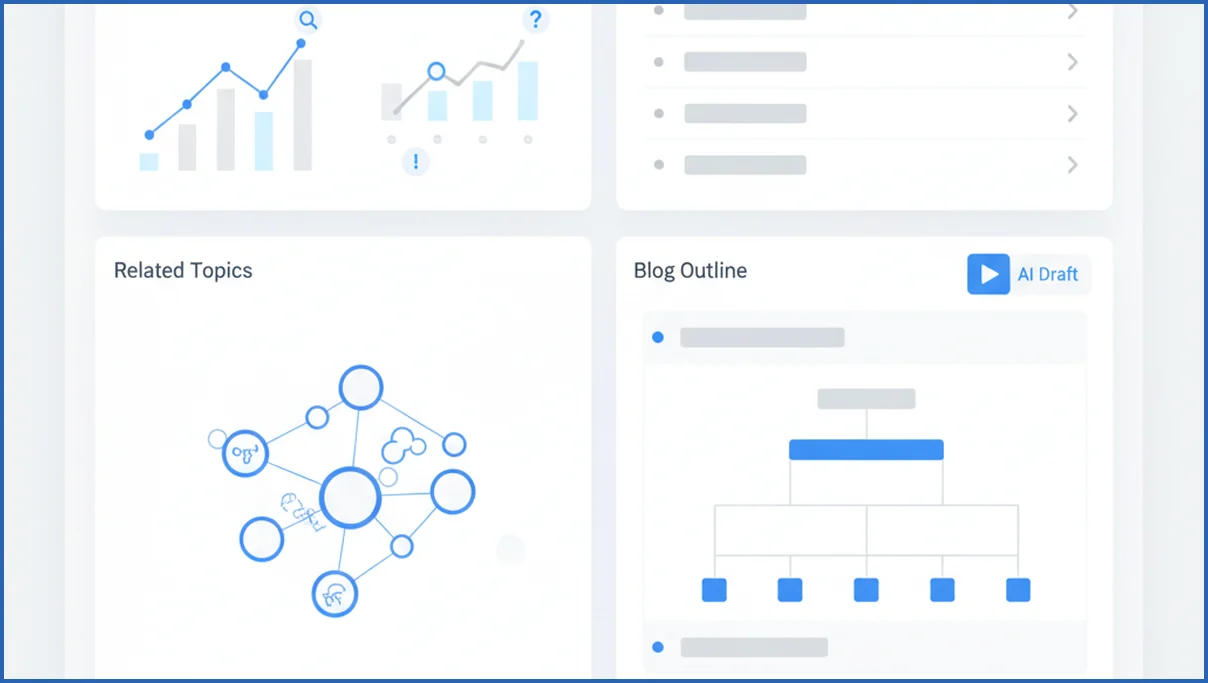
Draft Faster Without Losing Your Voice
Draft section by section. A single huge prompt usually produces padded intros, repeated points, and generic transitions. Feed AI your outline, target reader, banned phrases, and one short writing sample. Then ask for one section at a time with a strict word range.
Voice control needs constraints, not adjectives. “Write like us” is weak. “Use short sentences, challenge vague claims, and include one concrete example per section” works better. If you are building around AI search visibility, align those prompts with your answer engine optimization goals too.
Edit for Accuracy, SEO, and Readability
The edit is where weak AI content gets caught. Check every number, named tool, and sourced claim. Trim throat-clearing. Replace soft verbs with direct ones. Make sure the title, H2s, internal links, and intro all reflect the primary topic without repeating the keyword awkwardly.
A useful pass is to compare the draft with page performance data. Pull impressions, CTR, and near-ranking queries from GA4 and analytics workflows or Search Console, then tighten sections around terms already earning visibility. After that, review headings, sentence length, and transitions out loud.
If you need a checklist, use this order: facts, intent match, structure, on-page SEO, readability, then brand voice. That sequence prevents cosmetic edits from hiding strategic problems.

Choose the Best AI Blog Writing Tools
There is no single best tool. Pick based on the job. General models help with ideation and drafting. SEO suites help with SERP analysis and content scoring. Data connectors matter when you want drafts informed by your own performance, not generic web patterns.
| Feature | General LLM | SEO Suite | Verdict |
|---|---|---|---|
| First draft quality | Usually stronger | Often templated | General LLM wins |
| SERP guidance | Needs manual input | Built in | SEO suite wins |
| Site data access | Needs connectors | Varies by tool | Check integrations first |
| Cost control | Often cheaper | Higher monthly fees | Depends on volume |
Some dedicated tools are better at workflow management than raw writing quality. For a broader breakdown, see this AI content generator comparison.
Common AI Blog Writing Mistakes to Avoid
The biggest mistake is asking AI to write a full post from one keyword and publishing the result after a light skim. That is how you get filler, made-up details, and the same article your competitors already have.
Another mistake is skipping source material. Give the model real inputs: SERP notes, customer objections, product facts, and performance data. Random prompting creates random output. A measured workflow creates content you can actually trust.
How Google AI Mode Changes AI Blog Writing Workflows
Google AI Mode changes what a strong draft must do before it ever reaches an editor. Instead of chasing one exact keyword, writers need posts that answer layered follow-up questions, surface clear evidence, and make extraction easy for AI-generated responses. Google has framed AI Mode as a more advanced search experience for complex, multi-part questions (per Google announcements and public demos in 2025). That means weak filler, vague claims, and buried answers create more risk.
In practice, your workflow should add an answer-design step between outlining and drafting. Build sections around specific user tasks, not just subheadings. Put the direct answer near the top of each section, then expand with examples, tradeoffs, and proof. This approach overlaps with answer engine optimization, where clarity and retrieval matter as much as traditional on-page polish. AI can help generate drafts fast, but editors still need to tighten facts, structure, and source quality.
- Start each section with a plain-language answer in one or two sentences.
- Add verifiable specifics like dates, tools, pricing, or process steps.
- Revise for scannability so both humans and systems can parse the page quickly.
Frequently Asked Questions
Can you use AI to write a blog post?
Yes, but it works best when AI handles parts of the process, not all editorial decisions. Use it for research summaries, outlines, section drafts, and rewrite passes. Keep humans responsible for topic choice, original examples, factual checks, and final voice. That split saves time without turning the post into generic noise.
Which is the best AI to write a blog?
The best option depends on your workflow. A strong general model often writes better prose and follows nuanced prompts more reliably. An SEO platform may do a better job with SERP analysis, content scoring, and team workflows. If your process depends on first-party data, integrations matter more than headline writing quality.
How do I make AI writing sound more human?
Give the model constraints, not vague style requests. Provide a short brand sample, define banned phrases, ask for concrete examples, and draft in sections. Then edit hard for rhythm, specificity, and point of view. Most AI-sounding copy comes from loose prompts and weak editing, not from the model alone.
Is AI blog writing good for SEO?
It can be, if the content matches search intent and adds something useful. Search performance comes from relevance, structure, clarity, and trust signals, not from whether a human typed every word. Thin AI content still performs badly. Strong briefs, original insights, and post-publication updates matter far more than the drafting method.
How do I check AI content for accuracy?
Verify every claim against primary sources, product docs, or your own data. Check dates, feature names, pricing, and statistics one by one. If the model cannot cite a source, treat the claim as unverified. A practical rule helps: any sentence with a number, superlative, or named entity gets reviewed before publishing.
Should I disclose when AI helps write a post?
Usually, disclose when AI had a meaningful role in drafting, research synthesis, or editing, especially in regulated or trust-sensitive industries. For standard marketing content, policies vary by brand. The safer approach is to set an internal rule and apply it consistently. Readers care less about the tool than about accuracy and usefulness.
Your next step is simple. Pick one existing post, rebuild it with a fixed AI workflow, and compare drafting time, edit time, and post-launch performance after 30 days. If the process does not improve those three numbers, the issue is probably the workflow, not the model.
How should AI blog posts be optimized for Google AI Mode?
Optimize AI blog posts for direct answers, clean structure, and proof. Lead each section with a concise takeaway, then support it with examples, original insight, and cited facts. Use descriptive headings, strong internal links, and obvious next steps. Review pages with real performance data from Google Search Console analysis so you can improve sections that earn impressions but weak clicks.
Final takeaways
AI blog writing works best when the workflow is built for quality control, not volume alone. Google AI Mode raises the value of clear answers, solid evidence, and structured pages that are easy to interpret. Treat AI as a drafting assistant, not a final editor. If you need the bigger search shift behind these changes, read Google AI Mode explained and update your process before weak habits scale.