Last updated: July 2026
On Page SEO with AI: A Practical Playbook starts with a simple shift. AI speeds production, but Google still rewards pages that solve a search task better than the alternatives. Today, the edge comes from combining fast audits, stronger structure, and better evidence. AI can help you draft, cluster, and compare patterns, yet human judgment still decides what deserves prominence, proof, and revision.
TL;DR
- Use AI to audit, prioritize, and optimize pages faster.
- Match content to search intent before touching keywords.
- Improve titles, headings, links, and snippets for clicks.
- Keep human review in the loop for accuracy and trust.
What on page SEO means in an AI-assisted workflow
On page SEO is the work you do on the page itself to improve relevance, usability, and click appeal. That includes titles, headings, copy, internal links, images, schema-related content choices, and the page structure. In an AI-assisted stack, the difference is speed. AI can review 20 page elements faster than a human first pass and suggest patterns you might miss.
But AI does not know your commercial goal by default. It often writes toward generic completeness, not the page’s actual job. A signup page, product category, and glossary article need different optimization logic. If you are building around Claude or MCP tools, understanding how MCP servers fit the workflow helps because the model can pull live performance context instead of guessing.
Good on page SEO now sits closer to editorial operations than keyword stuffing. It also overlaps with answer visibility in AI search. If your team is adjusting for overviews and synthesized results, answer engine optimization principles belong in the same conversation.
Start with intent: identify the page’s job and audience need
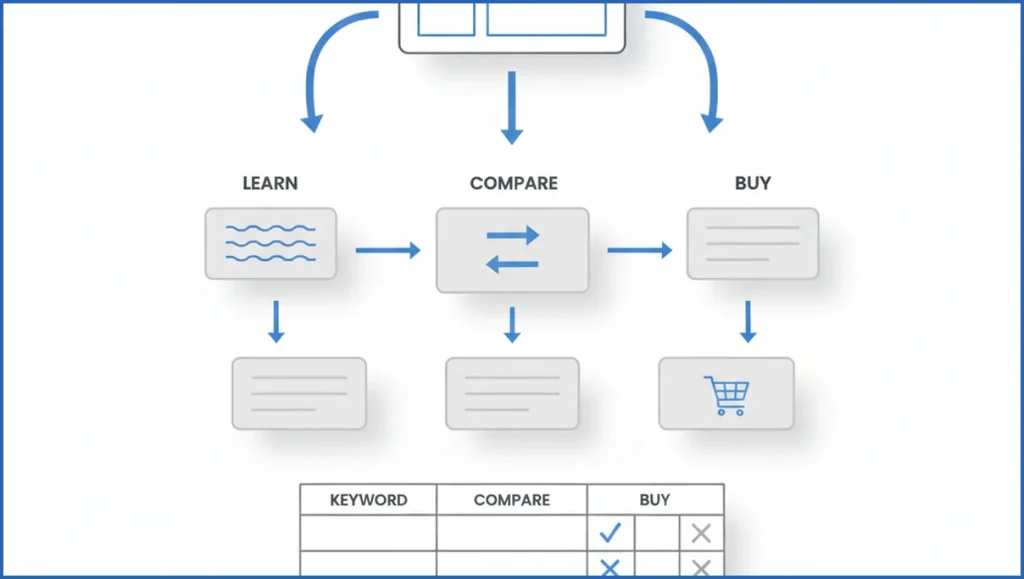
Before you edit a title tag, decide what success looks like for the page. Is the page meant to teach, compare options, capture a lead, or close a sale? Many pages underperform because they target a query class they cannot satisfy. A beginner guide should not read like a product page. A service page should not hide the offer under 1,500 words of theory.
Use AI to classify the top 10 results by intent. Ask it to label each result as informational, commercial investigation, transactional, or navigational. Then compare your page. If seven of ten results are comparison pages and yours is a thin sales page, you have a format mismatch. This is also where keyword clustering workflows save time, because they group adjacent queries before you write the wrong page.
A simple prompt works: “Review the top ranking pages for ‘on page seo’. Identify dominant intent, content format, likely audience maturity, and what a new page must include to compete.” Keep one primary outcome. For example, a SaaS blog post may target “teach and move readers to an audit template,” not “rank for every SEO term.”
Use AI to audit the page before you edit anything
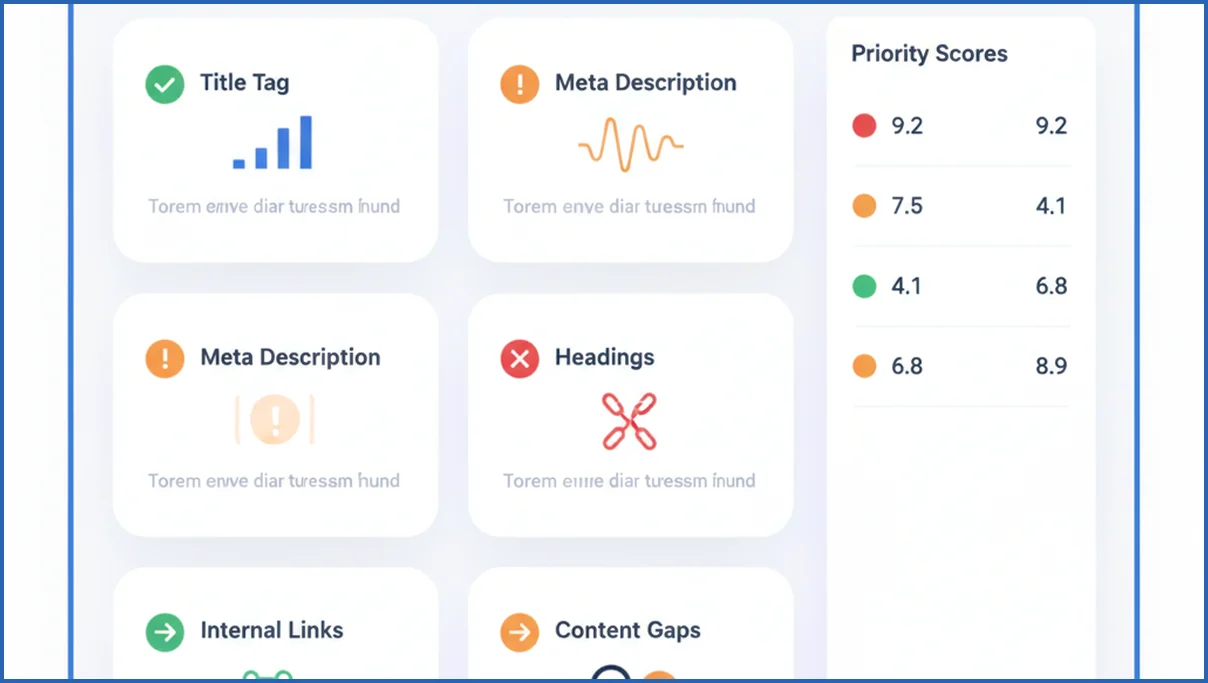
Run an audit before you rewrite. AI is useful here because it can score obvious issues in seconds. Check whether the title matches intent, whether the H1 duplicates the title badly, whether subheads cover core subtopics, whether internal links point to the right supporting pages, and whether the intro answers the implied query fast.
A practical setup is Claude plus Search Console and GA4 data through the Google Search Console MCP and the GA4 MCP tools. Pull queries, impressions, CTR, and engagement for one URL. If a page ranks for 47 queries in positions 8-12 and CTR is 1.9%, your first job is usually better alignment and snippets, not a full rewrite.
Example audit prompt: “For this URL, list the top five on-page fixes by likely impact on CTR, average position, and user satisfaction. Quote the exact section to change.” That gives you a prioritized edit list instead of vague advice.
Rewrite the page elements that influence clicks and relevance
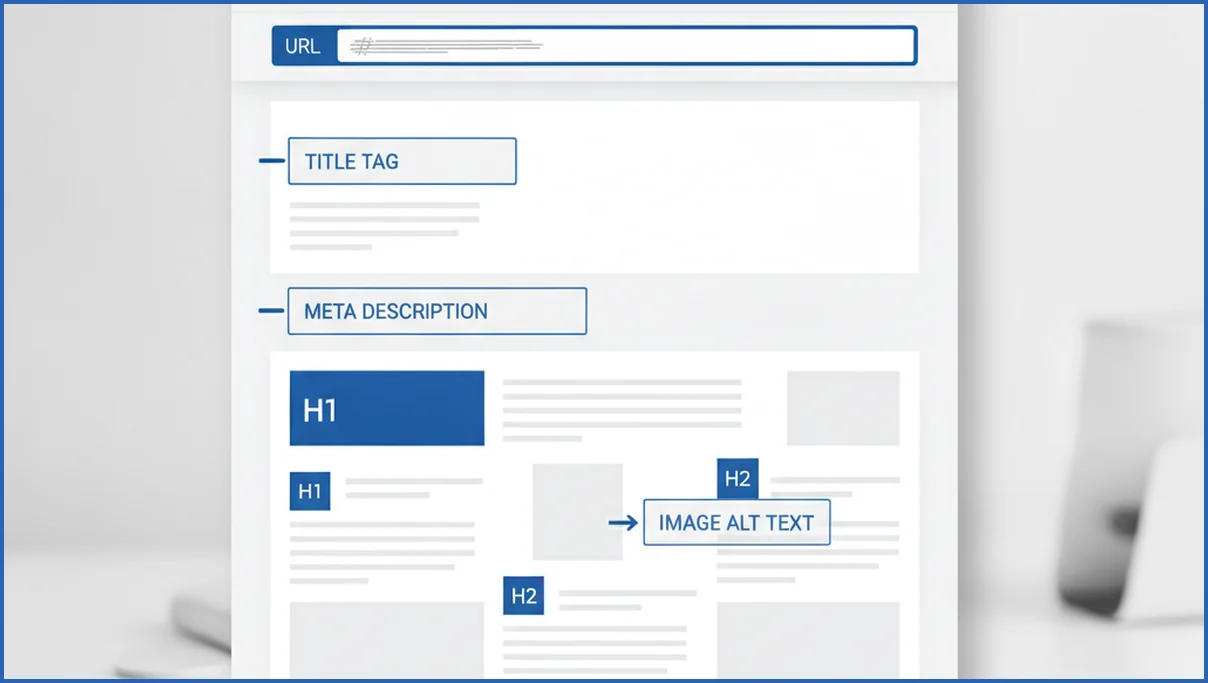
Start with the elements that shape the SERP impression. Titles, meta descriptions, H1s, and URL paths still set expectations. AI can generate options fast, but it needs constraints. Give it a character range, target query, search intent, and one reason the page is different. Generic title variants are easy. Specific titles that earn clicks are harder.
For example, change a title like “On Page SEO Guide” to “On Page SEO with AI: Audit, Rewrite, and Improve Pages Faster.” That version adds method and outcome. If you want a deeper framework for title work, this meta title optimization guide is still useful. Also review alt text. It should describe the image in context, not repeat the keyword blindly.
Use a simple prompt template:
Rewrite this page's SEO elements.
Primary query: on page seo
Intent: informational with practical workflow
Audience: in-house SEO manager
Need: improve CTR without sounding generic
Output: 5 title tags under 60 chars, 3 meta descriptions under 155 chars,
1 H1, 6 H2s, and recommended image alt text.
Then edit by hand. If every suggestion sounds like every other SEO article, it will perform like one.
Strengthen the body content with topical depth and proof
Thin pages usually fail for one of two reasons. They skip the hard questions, or they make claims without evidence. AI is good at spotting missing subtopics across competing pages. It is less reliable at providing proof. That part needs sources, product knowledge, screenshots, data, or lived experience.
Ask AI to compare your draft with the current SERP and list missing angles. Then add specifics. Mention a real metric, tool output, or workflow step. For instance, say “the page moved from position 11.2 to 7.4 after title and intro changes over 28 days,” not “rankings improved.” If you publish many AI-assisted pages, a structured AI copywriting workflow helps keep tone and factual checks consistent.
Depth also means usefulness. Add examples, objections, trade-offs, and next actions. A good on-page piece should reduce uncertainty, not just consume word count.
Build internal links and page structure that help crawlers and readers
Internal links help search engines understand relationships, but they also reduce user drop-off. Each page should sit in a clear cluster. Link up to a broader topic, across to relevant supporting pages, and down to the next practical step. Avoid stuffing the first paragraph with five exact-match anchors. Context wins.
Use AI to suggest link targets from your URL inventory, then review for actual fit. A clean process looks like this:
- List the page’s primary topic and two adjacent subtopics.
- Find one pillar page, two support pages, and one conversion page.
- Add links where the reader naturally needs context or next steps.
If your team needs a broader system, internal link building patterns are worth revisiting. Good structure helps both crawl paths and human momentum.
Measure results, then refine with an AI update loop
Do not treat optimization as one publish event. Measure impressions, average position, CTR, engagement, and conversion rate by page. Then update in controlled rounds. Change one meaningful layer at a time, such as title and intro first, then headings and missing sections, then internal links.
AI helps most after the first data cycle. Feed it 14 to 28 days of page metrics and ask for hypotheses, not conclusions. If you are building a broader process, this SEO strategy playbook for 2026 puts on-page work in the bigger system. Fast edits matter. Disciplined feedback loops matter more.
Optimizing for AI Overviews without chasing snippets
Many teams still treat AI Overviews like featured snippets with a new label. That usually leads to thin summary blocks and little supporting value. A better approach is to build pages that can be quoted because they are useful, not because they are formatted like a snippet. Google systems need a clean answer, but they also need surrounding context that confirms relevance and quality.
Start each major section with one direct response of 30 to 50 words. Then expand with criteria, steps, examples, and exceptions. If your page says Shopify product descriptions should include dimensions, materials, and delivery timing, show that pattern with an actual example. Specificity helps retrieval more than generic advice. This also protects your page if the query shifts from simple definitions to comparison or decision support.
It helps to target question clusters instead of one isolated phrase. Pages that answer adjacent intents often perform better because they give AI systems more ways to extract a relevant passage. That is one reason answer engine optimization overlaps with modern on-page SEO. You are designing content blocks that can stand alone, while still working together as a complete page.
Do not overreact to every new overview layout. Track impressions, clicks, and assisted visibility patterns in Search Console before rewriting everything. In many cases, stronger evidence, clearer headings, and tighter intros improve results more than aggressive snippet formatting.
Content formatting that helps AI systems extract answers
Formatting matters because AI systems often pull answers from predictable content units. Clear headings, short paragraphs, lists, comparison tables, and labeled examples make extraction easier. That does not mean writing robotic copy. It means reducing ambiguity. When a section answers one question at a time, both search engines and readers can understand the page faster.
Use heading hierarchies that reflect real user tasks. For example, a page about on-page SEO with AI might separate auditing, title tags, internal links, and refresh workflows. Under each heading, give one short answer first, then supporting detail. Bullet lists work well for criteria and steps. Tables work well for tool comparisons, especially when naming products like Ahrefs, Screaming Frog, Surfer, or Claude.
Entity clarity also helps. Name the platform, page type, audience, and outcome in the same section whenever possible. A sentence like “For a B2B SaaS pricing page, test a title tag that includes buyer stage and product category” is easier to extract than broad advice. If you want a workflow for finding these opportunities, Google Search Console analysis playbook is a practical next step.
Finally, keep important claims close to their proof. If you mention a CTR lift, include the time period, page type, and sample size nearby. That structure improves trust and reduces the chance of a useful answer being buried in filler text.
How Google AI Mode changes on-page SEO priorities
Google AI Mode rewards pages that answer tasks clearly, not pages that only repeat a keyword. That shifts on-page SEO toward explanation depth, scannable structure, and evidence. Google presented AI Mode as a more conversational search experience that can handle longer, multi-part questions (Google I/O 2025). For publishers, that means a page must serve both the fast extractor and the careful human reader.
In practice, your page should define the problem early, resolve it with direct language, and support claims with examples, screenshots, specs, or original observations. AI-assisted search also increases the value of context around the answer. A strong section explains who the advice fits, when it fails, and what tradeoffs matter. If you are building a broader response plan, Google AI Mode explained adds useful context.
- Lead with a concise answer in the first 100 words of key sections.
- Use specific entities, product names, and proof points instead of vague optimization language.
- Organize pages so headings, lists, tables, and examples map to real search tasks.
Frequently Asked Questions
Is SEO dead or evolving in 2026?
SEO is evolving, not dead. Search still needs pages that are relevant, trustworthy, and easy to understand. What changed is how visibility gets distributed across classic blue links, AI Overviews, snippets, and richer SERP features. Teams that win now focus less on raw ranking reports and more on intent coverage, answer quality, and strong page signals across the full journey.
Can AI write an entire on-page SEO page?
Yes, but that does not mean it should publish untouched. AI can draft structure, headings, summaries, and variant titles quickly. It usually struggles with product nuance, original evidence, and sharp editorial judgment. The best use is assisted production. Let AI create the first workable version, then add real examples, sources, screenshots, and a human edit that cuts filler.
What on-page SEO elements matter most for CTR?
Title tags matter most, followed by how well the result matches intent and whether the snippet promises a clear benefit. Meta descriptions can help, though Google often rewrites them. Clean H1 alignment, strong opening paragraphs, and relevant structured content also influence snippet selection. CTR improves when the page looks like the best answer for that exact search, not just a keyword match.
How often should I update optimized pages?
Use page type and volatility to decide. High-value pages with slipping CTR or rankings deserve a review every 30 to 60 days. Evergreen guides can often wait a quarter. Trigger updates when performance drops, the SERP format changes, competitors add better sections, or the page starts ranking for new adjacent queries that your current copy does not address well.
Does AI help with featured snippets and AI overviews?
It can help indirectly. AI is good at restructuring content into concise answers, step lists, definitions, and comparison blocks that are easier for search systems to extract. It can also spot which questions your page answers poorly. Still, snippet and overview inclusion depend on many factors. Clear formatting helps, but authority, trust, and query context still shape who gets cited.
What is the difference between on-page and technical SEO?
On-page SEO focuses on the content and elements on a specific page, such as titles, headings, copy, links, and media context. Technical SEO covers crawlability, indexation, site architecture, speed, rendering, canonicals, and structured implementation. One without the other creates bottlenecks. A great page cannot perform if search engines cannot process it well, and a perfect technical setup cannot save weak content.
How do I avoid keyword stuffing when using AI?
Give AI a primary query, a few related concepts, and a plain instruction to write naturally for humans first. Ask it to avoid repeating the exact phrase unless needed for clarity. Then edit with a simple check. If a phrase sounds forced when read aloud, cut it. Strong pages use semantic coverage, examples, and clear structure more than repeated keyword density formulas.
Pick one page that ranks between positions 5 and 15, pull its query and CTR data, and run the audit before rewriting anything. That order prevents busywork. If the page has weak intent match, no title tweak will save it.
How do I optimize a page for Google AI Mode?
Start by matching the page to a real task, then answer that task clearly near the top of each section. Use descriptive headings, short paragraphs, lists, and examples with named tools or products. Add proof, constraints, and next steps so the page is useful beyond one quote. For broader planning, SEO strategy in 2026 connects these page changes to site-level priorities.
Next steps for stronger AI-aware on-page SEO
AI Mode raises the bar for clarity, completeness, and structure. The winning pages are not the most automated ones. They are the most useful ones. Use AI to speed audits and drafting, then improve every key section with sharper answers, examples, and proof. When your page is easy to extract and worth visiting, you are better positioned for both AI visibility and human clicks.